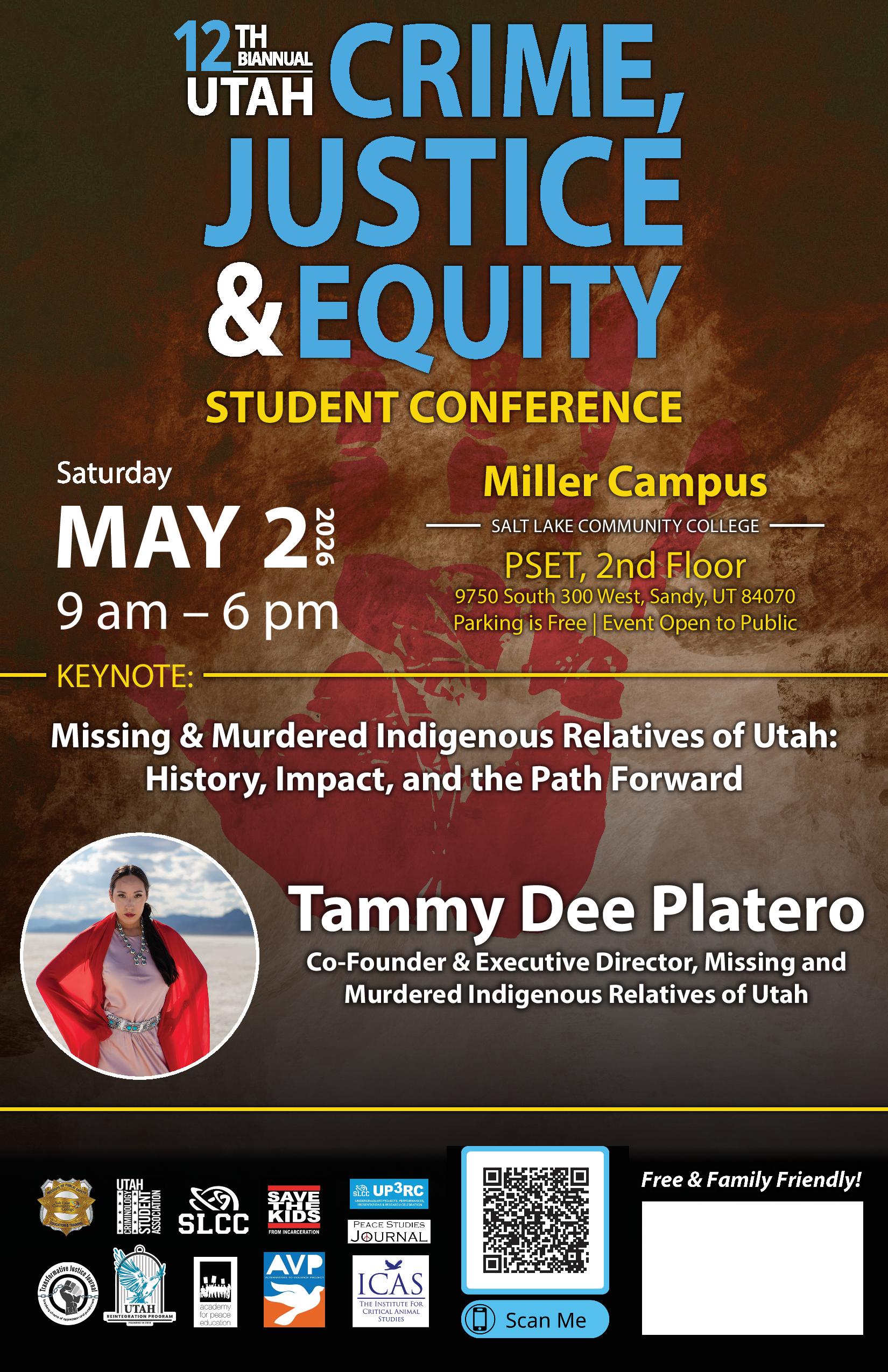
Saturday, May 2, 2026
9:00am to 6:00pm
Salt Lake Community College
Miller Campus
Address:
9750 South 300 West. Sandy, UT, 84070 USA
Parking is free.
Free and open to the public.
Calling Utah undergraduate and graduate students for presentations
Submit proposals to present or have posters here:
https://forms.office.com/r/bSFYptTx1r
Deadline for submissions is Friday, April 15, 2025
Conferences Chairs:
Stephanie Hoffman, Anthony J. Nocella II, David Robles, and Antonette Gray
Rooms:
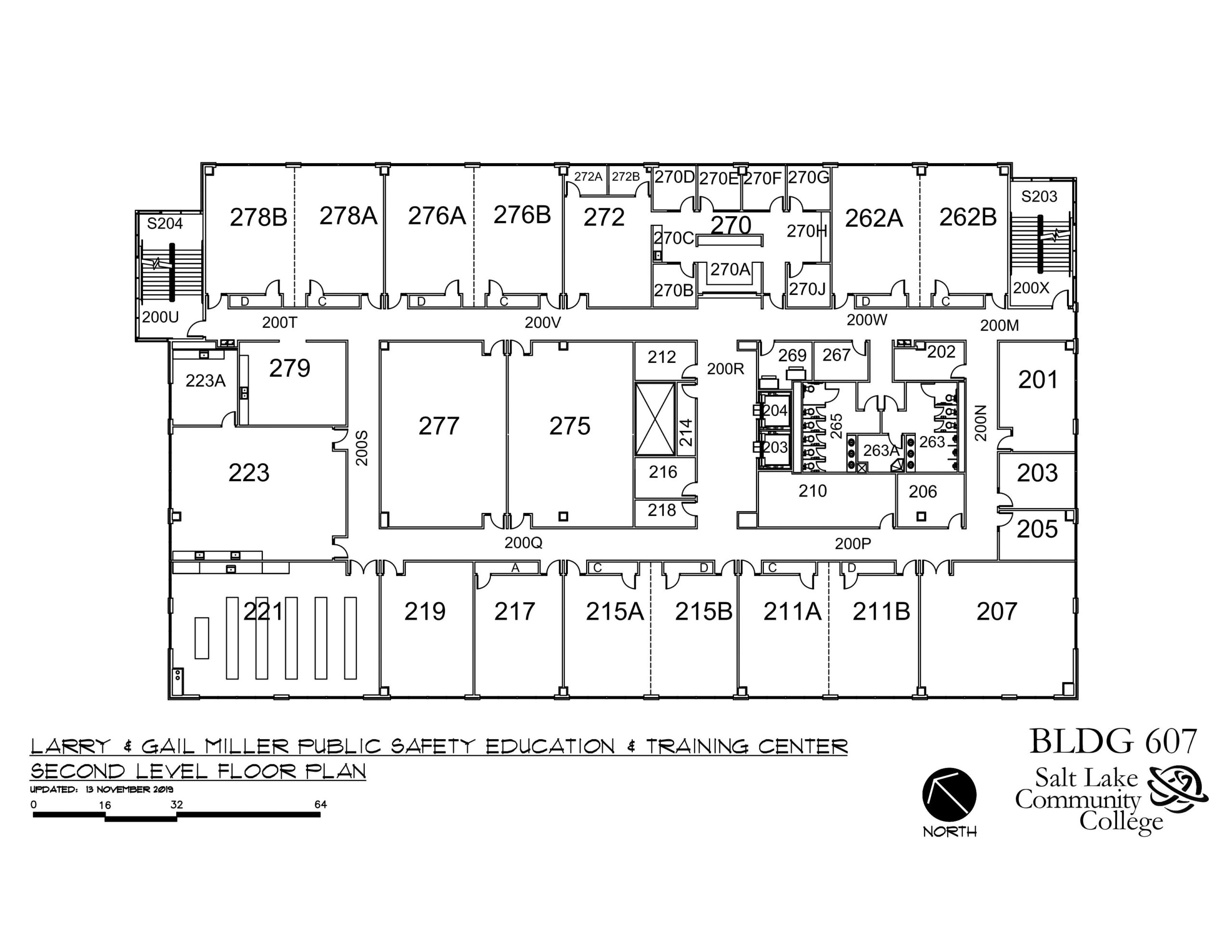
Room 1 (Zoom Streaming Link): PSET 219
Room 2: PSET 211
Room 3: PSET 215
Room 4 (Zoom Streaming Link): PSET 278
Forensic Science Lab Tour: PSET 221 [*Virtual Tour of “Mock” Crime Scene]
Lunch and Awards Room: PSET 278
Agency and Organizations’ Booths Room: Hall Near Elevator
Posters: Hall
Conference Mission:
The Biannual Utah Crime, Justice, and Equity Conference, founded in 2019 and hosted and sponsored by academic departments, colleges, universities, student clubs, and nonprofits, is open to all undergraduate and graduate students in Utah to present within the field of justice studies, criminology, criminal justice, peace studies, and conflict studies. The purpose of this conference is to promote scholarship, respect, community engagement, intellectual discovery, research, networking, collaboration, learning, innovation, inclusion, and a more educated democratic citizenship for a peaceful world.
SCHEDULE
(Based on USA Mountain Time)
8:40am– 5:00pm
Welcoming
8:40 – 9:00am
Session One
9:00am-10:00am
Room 1 (Zoom Streaming): PSET 219
Innocence Projects: The Devastating Implications of Wrongful Convictions
Chair: Antonette Gray, Associate Professor, Salt Lake Community College (SLCC)
Presenter One [9:00am-9:20am]
Title: Innocence Project Case: Ronald Jones
Presenter: Lexi Darden
Biography: Lexi Darden is a Criminal Justice Major in their sophomore year at Salt Lake Community College (SLCC). Lexi aspires to become a State Senator and intends to transfer to Utah State University in Fall of 2027 to complete their B.S. in Criminal Justice.
Abstract: Ronald Jones was wrongfully convicted of first-degree murder and aggravated sexual assault and was sentenced to death on January 1st, 1989, in Illinois. He served a total of 10 years, along with time spent on death row, due to the following contributing causes: a coerced confession, unvalidated and misleading forensic science, and investigative tunnel vision. Thankfully, he was exonerated by advances in forensic science and DNA retesting, which conclusively proved he was not the source of the biological evidence found on the victim’s body. The real perpetrator has yet to be identified. It is important to study cases like this because they expose serious flaws within the criminal justice system, particularly in how confessions and forensic evidence are handled. Understanding these failures can help prevent future wrongful convictions and ensure that justice is truly served for both victims and the innocent.
Presenter Two [9:20am-9:40am]
Title: Innocence Project Case: Ian Schweitzer
Presenter: Madison Varmette
Biography: Madison Varmette is a Criminal Justice Major in their sophomore year at Salt Lake Community College (SLCC). Madison aspires to become a Defense Intelligence Agent and intends to transfer to SUNY Plattsburgh in Fall 2026 to complete their B.S. in Criminal Justice.
Abstract: Ian Schweitzer was wrongfully convicted of Kidnapping, Rape, and Murder and was sentenced to life in prison on February 16th, 2000, in Hawaii County, Hawaii. They served 23-years due to the following contributing causes: false confessions, unvalidated and improper forensic science. Thankfully, they were exonerated by proper DNA testing and genealogy forensics, and the real perpetrator was identified. This case is important to discuss because it blatantly shows a miscarriage of justice. It needs to be a learning experience for future investigation and forensics to understand proper techniques within each field of criminal justice.
Presenter Three [9:40am-10:00am]
Title: Innocence Project Case: Rafael Ruiz
Presenter: Arianna Samano
Biography: Arianna is a Criminal Justice Major in their sophomore year at Salt Lake Community College (SLCC). Arianna aspires to become an immigration Lawyer and intends to transfer to Weber State University in Fall 2026 to complete their B.S. in Philosophy.
Abstract: Rafael Ruiz was wrongfully convicted of First-Degree Rape, First-Degree Sodomy, First-Degree and Second-Degree Robbery, and First-Degree Sexual Abuse and was sentenced to 8 years and 4 months to 25 years on 02/27/1984 in New York City. They served 24 years due to the following contributing causes: eyewitness misidentification. Thankfully, they were exonerated by DNA. The real perpetrator has yet to be identified. Rafael Ruiz lost 24 years of his life due to misidentification and flawed forensic practices. His case demonstrates the dangers of suggestive procedures. When mistakes are made, not only does the real perpetrator go free, but the wrongfully accused have their lives made up for them. The justice system is designed to protect the innocent, but cases like Rafael Ruiz’s remind us that when mistakes happen, it is society’s responsibility to correct them.
*5 min. Q&A period after each 15 min. student presentation
Room 3: PSET 215
Chair: Anthony J. Nocella II, Associate Professor, Salt Lake Community College (SLCC)
Presenter One:
Titles: Racial Disparities in the Juvenile Justice System
Presenter: Amariah Ramos
Biography: Amariah Ramos is currently a student at Salt Lake Community College majoring in criminal
justice. She hopes to work with juveniles to keep them from getting incarcerated or reoffending.
Amariah grew up in Salt Lake City, Utah and has lived here her whole life. She has 3 siblings
but remains closest to her brother. She enjoys photography, being active by going hikes, and
reading books.
Abstract: This paper focused on the racial disparities in the juvenile justice system due to systemic bias
embedded within legal institutions. This paper examines how systemic bias contribute to unequal
treatment of minority youth during arrest, detention, and incarceration. Using scholarly research,
legal analyses, and historical cases such as the Central Park Five, the paper shows that youth of
color are more likely to face harsher consequences, including longer detention, placement in
secure facilities, and higher rates of transfer into adult courts and the adult criminal justice
system. The paper argues that addressing racial disparities in the juvenile justice system requires
reform such as bias awareness and policy changes. By addressing bias, the juvenile justice
system can ensure equal treatment and positive long-term outcomes for all youth.
Presenter Two:
Title: Law Makers Make Exceptions
Presenter: Bridger Rich
Biography: Bridger Rich is a student at Salt Lake Community College and is majoring in Criminal
Justice. He wants to pursue education and a career in the criminal justice field. Bridger Rich
grew up in Kaysville, Utah where he attended school, while also enrolling in many
extracurricular activities spanning from science to the fine arts. Bridger Rich spends his free time
working on his cars or playing a variety of instruments.
Abstract: This paper is on members of the government or those closely affiliated who change or
add laws to help themselves, family members, or businesses. For most instances of these unique
laws, when they are proposed or made, they are not illegal but questionable with the timing of
when they are made. In this paper, the main focus will be on J. Stuart Adams, a republican
senator for Utah State Senate’s Seventh District. In 2024, a bill was passed to amend a point in
the criminal justice system. The bill reduces sentencing of a sex crime against a minor if the
offender is eighteen and enrolled in high school.
Presenter Three:
Title: Reentry
Presenter: Nyankier Ngor
Biography: Nyankier Ngor is a current student at Salt Lake Community College majoring in Criminal
justice. She hopes to become a defense attorney in Salt Lake City, Utah. Nyankier grew up
Ethiopia, and moved to Salt Lake, Utah when she was ten years old with family, of 3 siblings
who love to go swimming. She volunteers at the local homeless shelters and love’s being around
her family and playing sports and hanging out with her friends.
Abstract: In this paper I will be examining the challenges formerly incarcerated individuals face as
they attempt to reenter society and the disconnect people face as they attempt to reenter society
and the disconnect between social expectations and the limited support that is available to them
even though individuals that are realist from prison are expected to do better and avoid returning
to the system, they have little support. I will focus on 4 key areas that shape the reentry process
employment, housing, supervision, and judgment. Securing a job is very difficult due to a
criminal record and employer discrimination. Housing is equally as difficult, there are financial
barriers, strict policies, and limited transitional programs which ends up leaving many without a
safe or stable living option. Supervision through probation or parole can create additional
pressure, with strict requirements that may hinder rather than support reintegration. Judgment p.
by exploring these interconnected issues, this paper highlights the need for stronger, more
realistic support systems for people returning from incarceration
Presenter Four:
Title: The Untouchable
Presenter: Lily Sabanosh
Biography: Lily Sabanosh is a current student at Salt Lake Community College majoring in
psychology and criminal justice, with plans to transfer to a four-year university and pursue a
master’s degree. She grew up in Boulder and moved to Salt Lake City in the summer of 2025 to
continue her education and explore new opportunities. Her academic interests focus on
understanding human behavior and the justice system, which connect to her long-term goals in
the field. Outside of school, Lily enjoys skiing, traveling, and spending time with her dog. She
currently works at Swig, where she has been employed for about four months, gaining customer
service experience while balancing her coursework.
Abstract: The United States criminal justice system shows clear sexism and classism in how it
handles sex trafficking. It often targets women and girls from low-income backgrounds and
criminalizes victims instead of holding traffickers and buyers accountable. This paper examines
sex trafficking as a social problem tied to gender inequality and economic disadvantage, using
the case of Jeffrey Epstein to show how wealth and connections can protect offenders. Epstein’s
lenient treatment stands in contrast to the routine arrest of victims for crimes they were forced
into. This highlights how the system protects powerful individuals while further harming
vulnerable victims, and it points to the need for reforms that focus on victim protection and
accountability for traffickers and buyers.
Presenter Five:
Title: Delayed Law Enforcement Response to Cybercrimes
Presenter: Gabrielle Louisse DJ. Mendoza
Biography: Gabrielle Louisse DJ. Mendoza is a student at Salt Lake Community College, majoring in
Criminal Justice. With aspirations of pursuing a career in the forensic field, specifically as a
forensic analyst or scientist, she aims to advocate for equitable practices in technology and
justice. Growing up in Bulacan, Philippines, she has been actively involved in various academic
clubs focused on technology, sciences, and ethics. In her free time, she enjoys learning
programming skills, reading books, watching crime documentaries, playing mystery games, and
writing opinions about issues occurring in society.
Abstract: This paper is focused on how cybercrime is emerging as one of the most pressing social
problems of the 21st century, yet law enforcement agencies continue to struggle with identifying,
recording, and responding to these offenses in a timely and effective manner. This paper
examines the persistent gap between cybercrime occurrence and law enforcement response,
exploring the definition and scope of cybercrime, the behavioral and social drivers that cause it,
and the systemic obstacles that delay or prevent adequate policing. Drawing on peer-reviewed
literature, FBI Internet Crime Complaint Center (IC3) annual reports, and government
assessments, the paper argues that delayed law enforcement response is the result of chronic
underreporting by victims, insufficient training and resources at local agencies, jurisdictional
ambiguity, and a fragmented reporting infrastructure. The effects of this delayed response are
measured by economic losses totaling $16.6 billion in 2024, psychological harm to victims, and
diminished public trust in institutions. The paper also reviews emerging investigative techniques
and policy recommendations to close the response gap. Understanding these systemic delays is
essential for developing more effective, victim-centered, and technologically adaptive policing
strategies.
5 to 10 minutes for Q and A
Room 4: PSET 278
Innocence Projects: The Devastating Implications of Wrongful Convictions
Chair: Stephanie L. Hoffman, Associate Professor, Salt Lake Community College (SLCC)
Presenter One [9:00am-9:20am]
Title: Innocence Project Case: Eddie James Lowery
Presenter: Adam Hill
Biography: Adam Hill is a Criminal Justice Major in their sophomore year at Salt Lake Community College (SLCC). Adam aspires to become a Cybercrime Investigator and intends to transfer to Utah Valley University in Spring 2027 to complete their B.S. in Cybersecurity.
Abstract: Eddie James Lowery was wrongfully convicted of Burglary, Aggravated Assault, and Rape, and was sentenced to 11 years to life on January 7th, 1982 in Kansas. He served 9 years in prison before being let out on parole due to the following contributing causes: same blood type as the real perpetrator, within proximity of the crime when it happened, a coerced testimony, and DNA analysis did not exist yet. Thankfully, he was exonerated by procuring evidence of the case and submitting it to CODIS, proving his claim of innocence through DNA analysis. The real perpetrator, Daniel Brewer, was identified. Some key concepts to learn from Lowery’s case include exposing the ripple effect of police brutality via interrogations, abusing the ignorance and trust of the general public through manipulation and intimidation, abolishing the death penalty, and the requirement of formal education throughout law enforcement.
Presenter Two [9:20am-9:40am]
Title: Innocence Project Case:
Presenter: Raiza Aguirre Sanchez
Biography: Raiza Aguirre Sanchez is a Criminal Justice Major in their sophomore year at Salt Lake Community College (SLCC). Raiza aspires to become a Crime Scene Investigator (CSI) and intends to transfer to Weber State University in Fall 2026 to complete their B.S. in Criminal Justice.
Abstract: Archie Williams was wrongfully convicted of Attempted Murder, Aggravated Rape, and Aggravated Burglary, and was sentenced to life in prison without parole, on April 21, 1983 in Louisiana. They served 36 years due to the following contributing causes: eyewitness misidentification, cross-racial identification bias, unvalidated forensic practices, and lack of DNA testing. Thankfully, they were exonerated by DNA testing, which proved he was innocent, as well as fingerprint evidence that did not match him. The Innocence Project took on his case and re-investigated the evidence, and new forensic analyses excluded him as the perpetrator. The real perpetrator was identified. It is crucial to learn about these cases and raise awareness, as an increasing number of people are being wrongfully convicted—deprived of both their liberty and their lives—while the true culprit remains at large or evades punishment. Archie’s case stands as one of the most shocking in history; it tells the story of a man who lost half his life behind bars due to mistaken identity and flawed forensic evidence. These cases demonstrate the urgent need for reform within both the justice system and eyewitness identification protocols, highlighting, in particular, the critical importance of DNA evidence. Let us raise awareness to prevent wrongful convictions and protect all those innocent individuals.
Presenter Three [9:40am-10:00am]
Title: Innocence Project Case: Ron Williamson
Presenter: Lindsey Rieben
Biography: Lindsey Rieben is a Criminal Justice Major in their sophomore year at Salt Lake Community College (SLCC). Lindsey aspires to become an Attorney Specializing in Constitutional Law and intends to transfer to the University of Utah next semester to complete their B.S. in Legal Studies or Criminology.
Abstract: Ronald Keith Williamson was wrongfully convicted of First-Degree Murder and was sentenced to death on April 28, 1988 in Pontotoc County, Oklahoma. He served 11 years due to the following contributing causes: false confessions or admissions, government misconduct, inadequate defense, informants and unvalidated or improper forensic science. Thankfully, they were exonerated by DNA. The real perpetrator was identified. Understanding wrongful conviction cases involving false confessions, government misconduct, inadequate defenses, informants, and flawed forensic science highlights how the justice system can fail. Studying these cases helps to identify red flags, opportunities to improve practices and strengthen accountability to better protect the rights of innocent people.
*5 min. Q&A period after each 15 min. student presentation
Session Two
10:00am-11:00am
Room 1 (Zoom Streaming): PSET 219
Innocence Projects: The Devastating Implications of Wrongful Convictions
Chair: Antonette Gray, Associate Professor, Salt Lake Community College (SLCC)
Presenter One [10:00am-10:20am]
Title: Innocence Project Case: Marvin Grimm, Jr.
Presenter: Shelby Chancey
Biography: Shelby Chancey is a Criminal Justice Major in her sophomore year at Salt Lake Community College (SLCC). Shelby aspires to become a Medicolegal Death Investigator (MDI) and intends to transfer to Oregon State University in 2027 to complete their B.S. in Bio-Health Sciences.
Abstract: Marvin Grimm, Jr. was wrongfully convicted of Murder, Sodomy, and Abduction with Intent to Defile; he was sentenced to life in prison with the possibility of parole in May, 1976 in Richmond, Virginia. He served 44 years due to the following contributing causes: false confession and incorrectly presented serological evidence. Thankfully, they were exonerated by testing the DNA in the serological evidence, which proved Mr. Grimm’s innocence. The real perpetrator has yet to be identified. Marvin Grimm, Jr.’s case embodies the importance of appropriate investigative techniques to prevent false confessions. This case is also one that demonstrates the importance of cross-analyzing serological evidence to confirm the results, which makes it difficult for bias to be used against the accused.
Presenter Two [10:20am-10:40am]
Title: Innocence Project Case: Bennie Starks
Presenter: Jonathan Gibbon
Biography: Jonathan Gibbon is a Criminal Justice Major in their freshman year at Salt Lake Community College (SLCC). He aspires to become a Police Officer and intends to transfer to Weber State University in Fall 2026 to complete his B.S. in Criminal Justice.
Abstract: Bennie Starks was wrongfully convicted of Aggravated Criminal Sexual Assault, Attempted Aggravated Criminal Assault, Aggravated Battery, and Unlawful Restraint, and was sentenced to 60 years on 09/25/1986 in Illinois. They served 27 years due to the following contributing causes: eyewitness misidentification and improper forensic science. Thankfully, they were exonerated by retesting forensic evidence. The real perpetrator has yet to be identified. It is important to learn about this case because it shows how even the people who are tasked to always tell the truth, such as forensic scientists, can sometimes lie and must be kept in check. We as a society must take into account that people make mistakes or do not have the best intentions at heart.
Presenter Three [10:40am-11:00am]
Title: Innocence Project Case: Luis Diaz
Presenter: Madeline Wallace
Biography: Madeline Wallace is a Criminal Justice Major in their sophomore year at Salt Lake Community College (SLCC). Madeline aspires to become a Forensic Psychologist and intends to transfer to Nova Southeastern University in Fall 2026 to complete their B.S. in Psychology and Criminology.
Abstract: Luis Diaz was wrongfully convicted of Kidnapping, Sexual Battery, and Aggravated Assault and was sentenced to 13x Life plus 55 years on May 9, 1980 in Florida. They served 25 years due to the following contributing causes: eyewitness misidentification and unvalidated or improper forensic science. Thankfully, they were exonerated by DNA testing. The real perpetrator has yet to be identified. It is imperative to become aware of cases like these where individuals have been wrongfully convicted. These cases represent failures of our criminal justice system and cause irreparable harm not only to the wrongfully convicted but to their family and loved ones. To become aware is to become motivated to take action to prevent such injustices from occurring in the future.
*5 min. Q&A period after each 15 min. student presentation
Room 2: PSET 211
Chair: David Robles, Assistant Professor, Salt Lake Community College (SLCC)
Title: Media Representations of Crime and Identity in the U.S. Criminal Justice System.
Presenter: Amaris Loza
Biography: Amaris Loza, A Criminal Justice major at SLCC, is working toward a degree with a planned graduation in May 2027. They intend to continue their education at Utah Valley University that fall to earn a bachelor’s degree. Currently exploring various career interests, such as crime scene investigation, criminal profiling, and crime prevention, they are committed to making a meaningful impact within the justice system.
Abstract: This study explores the influence of media representations on perceptions of crime and identity within the U.S. criminal justice system. Focusing on the role of racial profiling in news coverage, the research analyzes how American media constructs narratives around suspected criminals and examines the resulting effects on public attitudes, legal proceedings, and justice outcomes. By investigating the intersection of media, race, and criminality, the study reveals how biased portrayals contribute to societal stereotypes and shape responses to crime and punishment. The findings underscore the importance of critically assessing media practices to promote fairness and equity in the criminal justice system.
Title: The Criminalization of Immigration and the construction of the “Illegal” American Identity.
Presenter: Amna Latif
Biography: Amna Latif is a college student studying both business and social work, combining her interest in leadership with a passion for social justice. She has experience in peer mentoring, which has strengthened her communication and leadership skills. Her academic focus explores how business practices and social systems impact marginalized communities, particularly in areas such as immigration and access to resources. Amna aims to use her education to create meaningful change by promoting ethical leadership, community empowerment, and more inclusive policies.
Abstract: This project explores how the label “illegal” shapes the treatment and perception of undocumented immigrants within the United States. Drawing on scholarly research, media analysis, and immigration policy, the study examines how language influences public opinion and interactions with the criminal legal system. The term “illegal” not only criminalizes immigration status but also contributes to racialized stereotypes that affect law enforcement practices and social attitudes. By analyzing the intersection of race, citizenship, and political discourse, this research highlights how undocumented individuals are constructed as outsiders within American identity. Ultimately, the study aims to challenge dominant narratives and encourage a more nuanced understanding of immigration, emphasizing the human impact of labeling and systemic bias.
Title: In What Ways Do Racial and Gender Biases Influence The Subjective Labeling of Inmate Behavior and The Subsequent Severity of Punishment Types?
Presenter: Emily Tecuanhuehue Brito
Biography: Emily Tecuanhuehue Brito comes from an immigrants background, being first generation to pursue a higher education. Emily majors in Animation specifically in 2D. She is pursuing a career in storytelling through visuals to be able to show topics that are watered-down in today’s animation industry. Emily participates in research, preferably about Artificial Intelligence. Emily’s hobbies are animating, drawing, painting, writing, and ceramics.
Abstract: This research examines the disproportionate rates of institutional “punishment” and disciplinary sanctions levied against incarcerated women compared to their male counterparts. While men are more frequently incarcerated for violent offences, empirical data consistently demonstrates that women face significantly higher rates of formal disciplinary reports, often for “low-level” or subjective infractions such as “disrespect,” “disobedience,” or “emotional outbursts.”
Title: Language as method: forging perceptions of immigration & the immigrant experience
Presenter: Talita Jada
Biography: Talia Jada (she/her) is a chemistry AS honors student at SLCC, whose personal and academic work is deeply rooted in matters of equity and justice. As an international student who spent most of her early life in Cairo (later attending high school in NH) Talia brings a global perspective to her work and interactions. She plans on pursuing a bachelor’s degree in chemistry-in addition to a complimentary field- with aspirations in chemical research. Alongside her academic path, she continues to develop her artistic practice in dance, visual, and musical forms. At her core, she is driven by a desire to connect with, and support others (even if the RBF says otherwise).
Abstract: Examined are the functions of language as a descriptive tool, and active sculptor of public policy and perception. Drawn upon are sources which interrogate the framing of ‘the immigrant’ across public and institutional contexts. Surveyed are works by the likes of: Otto Santa Ana (the use of dehumanizing metaphors in media) and J.D. Cisneros’s Immigrant as Pollutant ( identifying rhetorical patterns that frame the immigrant as a conditional participant). Additionally, language in policy is probed at its seemingly neutral/integrative tone, yet reinforcement of exclusionary standards. What is largely reflected, is what Herman and Chomsky would describe as a process of ‘manufacturing consent’ where public discourse normalizes certain political outcomes; ultimately, the policies are then facilitated through the obscurement of their ideological foundations. Through a micro-comparative analysis of dominant discourse (against localized initiatives) the re-imagining of language as an inclusive tool, is under_scored.
5 to 10 minutes for Q and A
Room 3: PSET 215
Chair: Anthony J. Nocella II, Associate Professor, Salt Lake Community College (SLCC)
Presenter One:
Title: The victimization of Mexican Americans by police and ICE
Presenter: Crystal Valencia
Biography: Crystal Valencia is a current student within Salt Lake Community College majoring in Criminal
Justice. Their goals are to one day become a Crime Scene Investigator within Utah, Ogden city.
Crystal was raised within West Valley Utah all her life up until 2022 where she later moved to
Layton City Utah. She is the eldest of three younger siblings, and is a part of the Mexican
American community, as her mother originated from a small town near Guadalajara Mexico, and
her step dad is from Mexico City. Her hobbies include art, reading books, guitar, and is always
reaching out to find new hobbies.
Abstract: This paper is focused on the impact of discrimination against the Mexican American community
within the U.S leading to the issue of rising arrest rates creating harmful ideologies and future
generations becoming affected by a multitude of unfortunate problems thereafter. Across the
states within the U.S, this paper has thorough research of providing evidence of arrest’s being
related to non crime and crime related arrests being made that have led to deportation’s across
the U.S resulting in great harm in the community that has ties to racial discrimination within the
criminal justice system.
Presenter Two:
Title: Drug Trafficking and Its Effect on the African-American Communities
Presenter: Majoie Ayele Ametitovi
Biography: Majoie Ametitovi is a Nineteen -year-old college student Born In America But her family are
refugees from Ghana and Togo West Africa. Her family has been here for over 25 years. After
graduating from high school at Granger High, Majoie is currently majoring in Criminal Justice
hoping to further that into Forensic Science. She is hoping to become one Forensic scientist and
Drug Trafficking and Its Effect on the African-American Communities
has dreams of working to help stop trafficking in the Federal Bureau of investigations or
wherever help is needed . In addition to studying and working full-time, she likes to spend time
with family and friends hiking and traveling . Most of the time she enjoys time alone and is very
much an introvert.
Abstract: Drugs have had a large effect on the African American community. The nineties crack epidemic
took place at such a pinnacle time in Black history changing the trajectory of the black
community forever. During the civil rights movement and the fight for freedom America was
introduced to opioids Heroin, crack cocaine, smokable cocaine and other opioids. Drugs were
being sold at low prices and were easily accessible leading to a rise in addictions, overdoses and
drug related crimes. This epidemic did not help shed a positive light on Black Americans; the
media began to get involved reporting on the soon coming “crack baby’s”. Rather than
recognizing this issue as a public health issue it was more severely punished with jail or prison.
Not much or any help at all was given to the victims. More impoverished communities were hit
the hardest with the introduction to drugs and the youth began to think of it more as a norm than
an issue. To this day African American youth and people in more impoverished areas are
struggling with the effects of the 90s Opioid epidemic cities are still being torn down and lives
are being turned around. All as a result of the abuse of illegal substances and the lack of support
and help these communities get.
Presenter Three:
Title: Racial Disparities in Sentencing in the United States
Presenter: Thalia Arambula
Biography: Thalia Arambula is an eighteen-year-old college student at Salt Lake Community College
(SLCC), majoring in criminal justice. She plans to become a juvenile counselor and intends to
pursue a bachelor’s degree in criminal justice and/or forensic science in order to work in crime
scene investigation. She grew up in Utah and has lived there her entire life. In the future, she
hopes to volunteer with the Village Project to help expand her experience working with youth.
She enjoys reading, watching winter sports, and spending time with her siblings
Abstract: This paper examines racial disparities in sentencing within the United States criminal justice
system from the early 2000s to the present. Although the United States Constitution guarantees
equal protection under the law, research and statistical evidence show that individuals of color
often receive harsher sentences than White individuals convicted of similar crimes. Numerous
studies also indicate that many members of the public believe the criminal justice system treats
people of color unfairly during the sentencing process. These disparities are influenced by
several factors, including judicial discretion, implicit racial prejudice, differences in legal
representation, and the racial composition of juries. Research also shows that individuals from
lower socioeconomic backgrounds often rely on public defenders and other forms of
government-funded assistance. However, public defender offices face limited resources and
heavy caseloads, which can affect the outcome of cases. The consequences of these disparities
impact individuals involved in the justice system and entire communities as well. Racial
inequality in sentencing often creates fear and mistrust toward law enforcement and the criminal
justice system. Addressing this issue requires reforms such as increasing funding for public
defender systems and mandatory bias training for prosecutors and other legal representatives.
Presenter Four:
Title: Child Human Trafficking to the United States
Presenter: Alexandria Alena Caro
Biography: Alexandria Alena Caro is a current student at Salt Lake Community College majoring in
Criminal Justice. She was born and raised in Salt Lake City, with her family of Six.
Being the first in her family to attend college she plans to graduate from Utah Valley University
with her bachelor’s in Criminal Justice. She plans to get into a police academy and help her move
forward with pursuing her dreams to become a Criminal Investigator. In her free time she enjoys
spending time with her family, going to the gym, exploring nature and doing small crafts.
Abstract:
Presenter Five:
Title: One social issue in the U.S. at of today
Presenter: Paula Rommina Cervantes Zamarripa
Biography: My name is Paula and I am a citizen in the United States. This essay will cover one of the main social
issues that a lot of people are struggling with as of now. For example, inflation and very high costing
properties that people like me can barely afford. I come from a family of 5, where teamwork and
perseverance is part of daily life. I am eighteen years old and attend Salt Lake Community College, this is
my second semester as an undergraduate. My family traveled to the U.S. in 2013 by car, it took us two
days to make it through the border and into the United States. By the time we settled down in Utah, time
had passed and eleven years flew by before I went back to Mexico. During high school, I used to work as
a waitress at Vietopia Bistro but left the workplace due to billing issues. As of today, I work a part time
job as a shift leader at Savers while attending college in the mornings.
Abstract: This essay will contribute greatly to my criminal investigation class. I will specifically be covering
America’s obsession with exoticism as well as the effect it gives people and why researchers should
investigate topics like this. What is exoticism? When a person is eroticly obsessed with someone or
something foreign, from another place. There’s a variety of people who are affected by this and are
introduced at a young age to fetishes like these but most importantly, sex trafficking rings or organizations
are founded by exoticism and money. Some information was retrieved from the Salt Lake City
Community College Library webpage.
5 to 10 minutes for Q and A
Room 4: PSET 278
Innocence Projects: The Devastating Implications of Wrongful Convictions
Chair: Stephanie L. Hoffman, Associate Professor, Salt Lake Community College (SLCC)
Presenter One [10:00am-10:20am]
Title: Innocence Project Case: Andre Hatchett
Presenter: Hasiby Martinez Carmona
Biography: Hasiby Martínez Carmona is a Criminal Justice Major in their freshman year at Salt Lake Community College (SLCC). Hasiby is a Certified Paralegal who aspires to become a Victim Advocate with the Utah Coalition Against Domestic Violence.
Abstract: Andre Hatchett was wrongfully convicted of Second Degree Murder and was sentenced to 25 years to life in prison on February 19, 1992 in New York. He served 24 years and 21 days (25 years) due to the following contributing causes: eyewitness misidentification, perjury or false accusation, government misconduct, inadequate legal defense, and exculpatory evidence that was not presented at trial. Thankfully, he was exonerated by evidence discovered by the Conviction Review Unit in the District Attorney’s file that the only eyewitness was smoking crack on the day of the crime, that he had initially identified another person as the killer, and that the burglary charge for which this alleged eyewitness was in custody when he pointed Hatchett as the killer was dismissed. None of this information was disclosed to Hatchett’s defense lawyers. The real perpetrator has yet to be identified. It is important to learn about this case for different reasons. Race likely played a role due to the lack of investigation and interest from the authorities, which was obvious from the beginning. The lack of evidence gathered at the crime scene, the negligence in establishing a timeline that could lead to the real perpetrator, the corruption in what the officers incurred, base an entire case in just one alleged eyewitness, knowing that it is not enough to reach the standard set beyond a reasonable doubt, and the numerous systemic fails withing the legal process that put an innocent person behind the bars for twenty five years, are why it is important to be aware of how wrong can go things when you do not do your work the way you should do it. Learning from past mistakes should be a mantra for law enforcement, criminal investigators, agencies, and other judicial bodies in charge of administering justice in order to ensure the integrity of the investigations; create protocols and procedures that are legally binding and establish clear and fair sanctions for the lack of ethics and poor performance at work.
Presenter Two [10:20am-10:40am]
Title: Innocence Project Case: Jane Dorotik
Presenter: Vanessa Santiago
Biography: Vanessa is a Criminal Justice Major in their sophomore year at Salt Lake Community College (SLCC). Vanessa aspires to become a Victim Advocate and intends to transfer to Utah Valley University in Fall 2026 to complete their B.S. in Criminal Justice.
Abstract: Jane Dorotik was wrongfully convicted of murder and was sentenced to 25 years to life on June 12, 2001 in San Diego county, California. They served 19 years due to the following contributing causes: false or misleading forensic evidence, perjury or false accusation, official misconduct, and inadequate legal defense. Thankfully, they were exonerated by DNA evidence. The real perpetrator has yet to be identified. It is important to learn from Jane Dorotik’s case as it highlights flaws within the justice system, the inclusion of the “CSI effects”, and prosecution only allowing themselves to take into consideration what they thought was good enough, which led to 19 years of wrongful incarceration. Highlighting the importance of requiring thorough forensic review, better sharing of evidence, and access to DNA testing after conviction to help prevent wrongful convictions in the future.
Presenter Three [10:40am-11:00am]
Title: Innocence Project Case: Alfred Swinton
Presenter: Alfred Williams
Biography:
Abstract:
*5 min. Q&A period after each 15 min. student presentation
Session Three
11:00am-12:00am
Room 1 (Zoom Streaming): PSET 219
Innocence Projects: The Devastating Implications of Wrongful Convictions
Chair: Antonette Gray, Associate Professor, Salt Lake Community College (SLCC)
Presenter One [11:00am-11:20am]
Title: Innocence Project Case: Keith Allen Harward
Presenter: Madison Galt
Biography: Madison Galt is a Criminal Justice Major in their sophomore year at Salt Lake Community College (SLCC). Madison aspires to become a Paralegal and intends to transfer to Weber State University in Fall 2026 to complete their B.A. in Criminal Justice.
Abstract: Keith Allen Harward was wrongfully convicted of Murder and Sexual Assault and was sentenced to Life in Prison on September 19th, 1982, in Virginia. He served 33 years due to the following contributing causes: eyewitness misidentification and unvalidated or improper forensic science related to bite mark analysis. Thankfully, he was exonerated by DNA, and the real perpetrator was identified. Keith is at least the 25th person to have been wrongfully convicted or indicted based at least in part on bite mark evidence. For decades, courts have permitted forensic dentists to testify in criminal trials even though there is a complete lack of scientific support that a suspect can be identified from a bite mark on the victim’s skin. When courts allow testimony that lacks scientific support, they transform the witness stand into a source of life-altering misinformation that leads to wrongful convictions. To prevent this, we must advocate for “junk science” laws that allow defendants to challenge convictions when the “science” used against them has since been debunked.
Presenter Two [11:20am-11:40am]
Title: Innocence Project Case: Ryan Matthews
Presenter: Whitney Roth
Biography: Whitney Roth is a Criminal Justice Major in their sophomore year at Salt Lake Community College (SLCC). Whitney aspires to become a Juvenile Probation Officer and intends to transfer to the University of Utah in Spring 2027 to complete their B.A. in Criminal Justice.
Abstract: Ryan Matthews was wrongfully convicted of First-Degree Murder and was sentenced to death on May 7, 1990 in Louisiana. They served 7 years 8 months due to the following contributing causes: eye witness statements and a false confession. Thankfully, they were exonerated by DNA evidence, and the real perpetrator, Rondel Love, was identified. This case highlights how easily the justice system can get it wrong when eyewitness testimony is too heavily relied on. Ryan Matthews was sentenced to death for a crime he did not commit, which shows how serious the consequences are for these types of errors. Learning about cases like this can help us push for better investigative practices, the use of reliable forensic evidence like DNA, and safeguards to prevent false confessions. It also reminds us why it is so important to question evidence and protect the rights of suspects to avoid wrongful convictions in the future.
Presenter Three [11:40am-12:00pm]
Title: Innocence Project Case: Johnny Tall Bear
Presenter: Shelby Ferkovich
Biography: Shelby Ferkovich is a Criminal Justice Major in their sophomore year at Salt Lake Community College (SLCC). Shelby aspires to become a Forensic Science Technician and intends to transfer to Utah State in Fall 2026 to complete their B.S. in Criminal Justice.
Abstract: Johnny Tall Bear was wrongfully convicted of First-degree Murder and was sentenced to life without parole on March 11, 1992, in Oklahoma. They served more than 26 years in prison due to the following contributing causes: eyewitness misidentification, and unvalidated or improper forensic science. Thankfully, they were exonerated by DNA. The real perpetrator has yet to be identified. Johnny Tall Bear was sixty-two upon his release, having spent a large portion of his life in prison for a crime he did not commit, and many other Native American individuals have experienced similar circumstances. To prevent further miscarriages of justice, it is vital to first recognize past biases and bring improper forensic techniques to light.
*5 min. Q&A period after each 15 min. student presentation
Room 2: PSET 211
Chair: David Robles, Assistant Professor, Salt Lake Community College (SLCC)
Title: What is the impact of large-scale deportation policies on the United States economy?
Presenter: Tiffany Sobeyda Rodas Vasquez
Biography: Tiffany Rodas is a Salt Lake City Community College student from Honduras, working towards a career in psychology. She hopes to help people find and accept who they are, so that they can live their best life. As the oldest of three and a first-generation college student, Tiffany is committed to her studies and continues working toward her goals. She hopes to use her knowledge to improve mental health awareness in Honduras. In addition to her studies in psychology, Tiffany also aspires to be a polyglot. Don’t be shy, help her practice her Japanese!
Abstract: What happens to the U.S. economy when large-scale deportation changes who is able to live and work in this country? This presentation explores that question by looking at how these changes may affect jobs, businesses, and daily life. It considers different ways the economy could respond and how communities might experience those shifts. The goal is to better understand how policy decisions can shape economic outcomes, while leaving space to think about what those impacts might look like in practice.
Title: Gender Inequality in Political Representation
Presenter: Theingi Kyaw
Biography: First of all, I am from Myanmar which is currently in a civil war. This topic comes to my mind what I experienced gender inequality in politics in my country. This is why I try to speak up and stand up for women who are not able to have the same opportunities as men through my presentation.
Abstract: This presentation explores gender inequality in political representation using research and real-world data. It focuses on how women are still underrepresented in political offices. It also discusses how gender stereotypes affect women candidates, how they are judged by appearance rather than their ability and skills. The presentation also explains why fewer women run for office, including lack of support and confidence. Overall, it highlights the need for equal opportunities and stronger support for women in politics.
Title: Domestic Abuse in Women
Presenter: Hser Eh
Biography: Hser Eh is a student who is interested in understanding social issues especially those affecting women in the United States. their work is shaped by personal experience with domestic abuse, which motivates them to learn more and raise awareness. They focus on how identity, inequality, and access to support can affect a women’s safety and wellbeing. through their research, Hser Eh hopes to help others better understand the challenges survivors face and why stronger support systems are needed.
Abstract: This project explores how domestic abuse affects different groups of women in the United States and how identity shapes their experiences. using peer reviewed research, I found that disabled women, older women, racially minoritized women, and college students all face unique risks and barriers when seeking help. The studies also show that abuse often gets worse during separation and that social conditions, like the COVID 19 pandemic or campus culture, can increase danger. these findings highlight how inequality, environment, and limited support systems influence women’s safety and access to resources.
Title: Stop Asian Hate
Presenter: Zen Gatoloai
Biography: Zen Gatoloai is a current student at SLCC dual majoring in English Studies and Computer Engineering, Zen is a huge advocate when it comes to social justice and the mindset of being “woke”, he enjoys being a leader amongst his peers helping inspire students to pursue opportunities outside of college.
Abstract: My presentation will be focusing on how dangerous stereotypes like the model minority myth and fetishization within the asian community dates back prehistorically to colonialism and how these kinds of stereotypes can lead to Anti-Asian violence and hate crimes, how we can be more aware of stopping this kind of thing from happening.
5 to 10 minutes for Q and A
Room 3: PSET 215
Chair: Anthony J. Nocella II, Associate Professor, Salt Lake Community College (SLCC)
Presenter One:
Title: Causes of Juvenile Recidivism
Presenter: Loyal B. Gobelman
Biography: Loyal Gobelman is currently enrolled at Salt Lake Community College (SLCC), and is majoring
in criminal justice. His goal is to find employment in criminal investigations or detective work;
and more specifically, to work with juvenile offenders and victims. He is working a part time job
as a host at Porcupine Pub and Grill, and using the money to further his education in order to
become better qualified to support his family and community. In his spare time he likes to seek
out music recommendations and expand his taste in music.
Abstract: This paper is going to focus on the discussion of juvenile recidivism; more specifically it will
focus on the causes of juvenile recidivism and the potential solutions that could be implemented
within communities in order to reduce the chances of juveniles becoming repeat offenders. This
discussion will be focused primarily within the United States and use data regarding national
averages and the statistics of specific states or regions that can demonstrate high or low juvenile
offense rates and high or low recidivism rates. This discussion will be based mostly on defining
statistics, causes and solutions to the problem of juvenile recidivism.
Presenter Two:
Title: Prevention Over Punishment: Catching Crimes Instead of Criminals
Presenter: Kamil Hans
Biography: Kamil Hansen is currently attending Salt Lake Community College, majoring in the field of
criminal justice. She plans on having a career in forensic science, with a particular fascination
towards forensic entomology. Her whole life has been in Utah, never living outside of the Salt
Lake valley, though she has visited multiple other States within America. Aside from
criminology, she enjoys learning about social sciences such as psychology, sociology, and
anthropology.
Abstract:
Presenter Three:
Title: Changing How Police Officers are Trained in the United States
Presenter: Liam Hardy
Biography: Liam Hardy is a student at Salt Lake Community College who is working towards obtaining his
associate’s degree in the field of criminal justice. Liam’s desire to major in criminal justice is due
to his goal to use both his intellectual and athletic abilities to their fullest potential while helping
people at the same time. Mr. Hardy was born in Uba City, California, and grew up in Salt Lake
City, Utah, after moving there at the age of one. During his free time, Liam enjoys dancing,
playing strategic video games, and learning other languages.
Abstract: The controversial topic of police brutality has been growing in our society since the early
twenty-first century, and it has elevated further in more current years. People see police officers
as violent and repressive to the people they are supposed to protect because of how different
forms of media portray them. On the contrary, police officers are trained rigorously in high
intensity scenarios constantly during their brief period of attendance at the police academy. In
order to lower public tension towards law enforcement officers and have police react
appropriately to diverse levels of contentious situations, police need more training.
Presenter Four:
Title: Reducing Sexual Abuse of Minors in the Foster Care System
Presenter: Timothy Heddlesten
Biography: Timothy Heddlesten is a United States citizen, born in the state of Utah in 1999. Timothy is a
student at Salt Lake Community College and is actively working towards his goal of becoming a
Lawyer, licensed through the Utah State Bar. Timothy has taken a number of jobs along the
Wasatch Front, including telecommunications, medical lab diagnostics, and document review for
an auto-accident law firm. Timothy has been pillar of the community, donating blood to the
University of Utah’s Primary Children’s Hospital, providing food and clothing to Salt Lake
City’s justice impacted community.
Abstract: The United States foster care system is managed by the States Division of Social Services. In
2019, 40% of the 400,000 children in the foster care system reported instances of sexual abuse
while in the system.
Presenter Five:
Tit;e: How the School System Affects Juvenile Justice
Presenter: Tia Kaheanokalani La’ulu
Biography: Tia Kaheanokalani La’ulu is an 18-year-old college student that attends Salt Lake Community
College. She has only lived in Utah her whole life but has explored most of the western coast of
the United States. After graduating from high school at Murray High, Tia is currently majoring in
Criminal Justice while also managing to study her general education. In addition to studying part
time, Tia also works part time at the Salt Lake Community College Jordan Campus Childcare
where she attends children under the age of 5. Outside of her busy school and work schedule, Tia
spends time taking Polynesian dance lessons on the weekends and during the summer. Sometimes
she likes to bake for her and her loved ones, including cookies, cake and brownies.
Abstract: The United States school system is not for everyone and there needs to be a change to how the
school system works. This paper is mainly focused on transforming K-12 education because
education can be dependent on recidivism for juvenile justice. Also, looking at similarities of how
being in school is like being in a jail or a prison. Especially for children who are under aged, their
brains are developing rapidly, so it is important to know how we treat these kids when they have
made mistakes. Some people forget that racism is the only systemic issue. This paper reminds us
that agism is also a problem because society should not treat kids as adults, nor discriminate people
just because they are older or younger than them.
5 to 10 minutes for Q and A
Room 4: PSET 278
CJ 2340-251: Forensic Photography Hands-On Workshop
Chair: Stephanie L. Hoffman, Associate Professor, Salt Lake Community College (SLCC)
Presenter Group One [11:00am-12:00pm]
Title: Bringing Crime Scene Evidence to Life With 3-D Photogrammetry
Presenters: Bryce Beesley, Lucy Herold, and Whitney Romig
Biographies: Bryce Beesley is currently a Criminal Justice Major at Salt Lake Community College (SLCC) in his sophomore year, who aspires to become a Medicolegal Death Investigator (MDI) and later a Crime Scene Investigator (CSI). Bryce has developed a strong foundation in forensics and investigative practice through his coursework at SLCC and participation in SkillsUSA Crime Scene Investigation (CSI) competitions. He also served as a Transporter with Care Center, which is contracted by the Utah Medical Examiner’s Office to assist with the recovery and transport of decedents from unexpected or suspicious death scenes. This has provided additional exposure to field investigation protocols and procedures. He intends to transfer to Utah Valley University (UVU) to pursue a B.S. in Forensic Sciences with a Forensic Investigation Emphasis in Spring 2027. Lucy Herold is currently a Criminal Justice Major at Salt Lake Community College (SLCC) in her sophomore year, who aspires to become a Forensic Psychologist. She has deepened her understanding of forensics by completing three forensic science courses at SLCC, a group Capstone Research Project, and competing in SkillsUSA Crime Scene Investigation (CSI) competitions for the past three years at the secondary and post-secondary levels. She intends to transfer to Utah Valley University (UVU) to pursue a B.S. in Psychology in Fall 2027. Whitney Romig is currently a Criminal Justice Major at Salt Lake Community College (SLCC) in her sophomore year, who aspires to become a Crime Scene Investigator (CSI). She has gained extensive hands-on experience through an internship with the South Salt Lake Police Department, SkillsUSA Crime Scene Investigation (CSI) competitions, along with coursework in three different forensic science classes and a group Capstone Research Project. Whitney intends to transfer to Utah Valley University (UVU) to pursue a B.S. in Forensic Sciences with a Forensic Investigation Emphasis in Spring 2027.
Abstract: Crime scenes only exist in their original form once, and traditional photography cannot always capture the full context, depth, spacing, and perspective of the scene. Photogrammetry offers a reliable, non-invasive method to preserve crime scenes, evidence, and measurements through detailed 3-D models created from overlapping photographs or videos. This hands-on workshop will explore how photogrammetry can be utilized in forensic science to improve and provide accessible and user-friendly documentation that will aid crime scene reconstruction efforts. Photogrammetry’s forensic utility, how it compares to more traditional documentation methods like 2-D photography and diagrams, and how to accomplish said technique via computer software and a smartphone app (i.e., 3DF Zephyr and Artec Studio App) will be discussed. Photogrammetry is a vital progression in preserving and documenting crime scenes that can ensure the transition from the field to the courtroom is seamless and evidence driven. The technique has not been widely adopted by forensic investigators, which makes training and equipping criminal investigators with accessible photogrammetry techniques essential to modernizing forensic workflows. *Attendees will need to download the Artec Studio app (Apple or Google Play store options) on their phone and create a free account in advance to capture and create 3-D photogrammetry models during the workshop.
*5 min. Q&A period after 55 min. student workshop
Lunch: 12:00pm to 12:30pm
Room: PSET 278
Facilitated by: Dr. Anthony Nocella II
Menu: Free Pizza and Juice (Vegan Options)
Moment of Silence for Lauren’s Promise: 12:30pm – 12:40pm
Room: PSET 278
Make Lauren’s Promise
Facilitated by: Interim Dean Cecile Delozier
Lauren’s Promise is a vow that anyone – faculty, staff, students, parents, and community members – can take to indicate to others that they represent a safe haven for sharing incidents of sexual assault, domestic violence, or stalking. Anyone who makes Lauren’s Promise will listen to and believe those individuals who are being threatened or experiencing sexual assault, dating violence or stalking and will help connect victims to support resources. By making Lauren’s Promise, individuals are helping to change campus cultures that respond poorly to dating violence and stalking throughout the nation.
I WILL LISTEN AND BELIEVE YOU IF SOMEONE IS THREATENING YOU.
12:40pm – 1:30pm – Keynote Speaker
Room: PSET 278
Title: Missing and Murdered Indigenous Relatives: History, Impact, and the Path Forward
Keynote Presenter: Tammy Dee Platero
Biography: Tammy Dee Platero is an urban auntie who has had to learn, unlearn, and forge new pathways toward belonging. Growing up at a distance from her Navajo family (born for the Edge of the Water clan), Dee has spent much of her life navigating the spaces between cultures and building deeper connection with community. She brings a background in computer science and technical consulting to Indigenous advocacy and serves as Co-Founder and Executive Director of MMIR Utah, working at the intersection of technology, community, and justice for Missing and Murdered Indigenous Relatives.
Abstract: In this keynote, Tammy Dee Platero, Co-Founder and Executive Director of MMIR Utah (a 501(c)(3) nonprofit), will ground the audience in the historical context of Missing and Murdered Indigenous Relatives of Utah and how that history connects to present-day systems, media narratives, and community realities. Tammy Dee will then highlight key findings and recommendations from Utah’s MMIR Task Force, and explain how those recommendations have directly informed MMIR Utah’s strategy and public-facing campaigns. The presentation will close with practical ways institutions and community members can support prevention, awareness, and accountability.

Awards: 1:30pm-2:00pm
Room: PSET 278
Recognizing the Outstanding Criminal Justice Awards
Chairs: Professors Stephanie Hoffman and David Robles, Salt Lake Community College (SLCC)
Outstanding Academic Achievement: Michael C. Miller, Brooke R. Hanna, Almedin Zahirovic, Madison P. Galt, and, Yuliza B. Perez
This biannual award is for a graduating criminal justice student at Salt Lake Community College that has the highest GPA overall. This award is an objective award that does not have a nomination process and is determined by comparing all GPAs of criminal justice student majors that are graduating that academic semester.
Outstanding Inclusivity and Equity Achievement: Abby Carroll
This biannual award is for a criminal justice student at Salt Lake Community College that has an active commitment and engagement in direct advocacy toward justice, equity, and inclusion of a marginalized segment of society such as, but not limited to, People of Color, immigrants, LGBTQ+, people with disabilities, those incarcerated, women, youth, survivors, unsheltered, economically disadvantaged people, nonhuman animals, and the environment. We recognize that oppression exists and that action needs to be taken to address inequity and injustices in society.
Outstanding Service Achievement: Timothy Heddlesten
This biannual award is for a criminal justice student at Salt Lake Community College that has an active commitment and engagement in serving voluntarily, and not as a paid job or internship, within the community at a government agency or social service nonprofit organization that is not religiously or politically affiliated. Serving others and the community is a central part of justice and a healthy community.
Outstanding Health and Well-being Achievement: Josie Counter and Charlee Paterakis
This biannual award is for a criminal justice student at Salt Lake Community College that has an active commitment and engagement in personal fitness, health, and mental well-being. We want to support students and not shame students for taking care of themselves over academics. Schools have led to a high rate of student anxiety, depression, unhealthy dietary and physical habits, and suicide. Further, the field of criminal justice has fostered similar habits, too. This person must regularly demonstrate in their personal life self-care, such as, but not limited to, exercising, involvement in organized athletic competitions, eating healthy, and seeking out counseling and advising.
Outstanding Rise Up Achievement: Amariah Ramos
This biannual award is for a criminal justice student at Salt Lake Community that has succeeded against many personal social adversities, such as death in the family, unsheltered, drug use, incarceration, domestic violence, or theft.
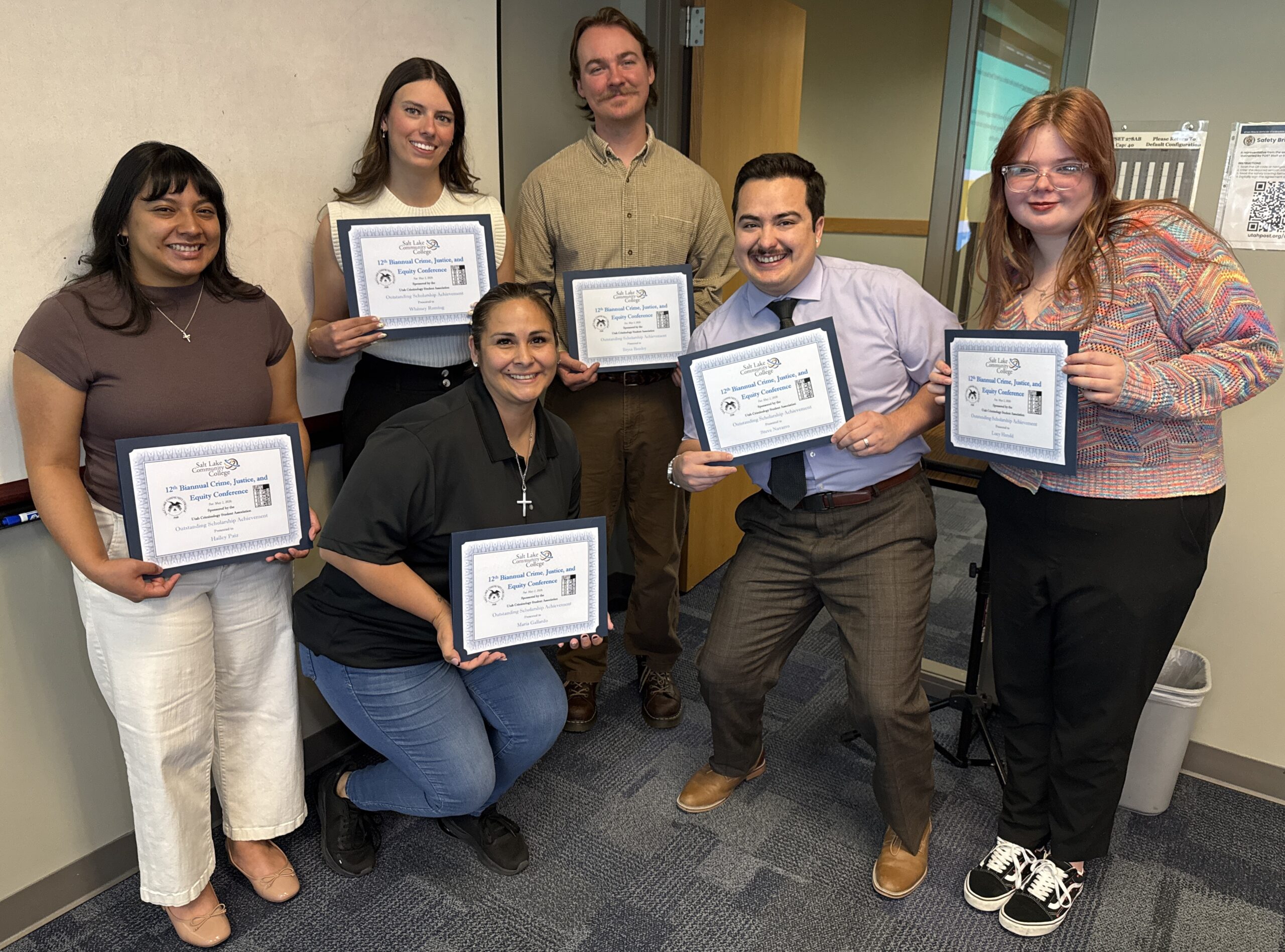
Outstanding Scholarship Achievement Award: Bryce Beesley, Maria Gallardo, Lucy Herold, Steve Navarro, Hailey Paiz, Whitney Romig, and Jessah Rylant
This biannual award is for a criminal justice student at Salt Lake Community that engages in research, scholarship, organizing academic publications and events, and participates in furthering their knowledge, education, and learning through reading, writing, attending forums, clubs, organizations, and watching films.
Outstanding Faculty:
Session Four
2:00pm – 3:00pm
Room 1 (Zoom Streaming): PSET 219
Innocence Projects: The Devastating Implications of Wrongful Convictions
Chair: Antonette Gray, Associate Professor, Salt Lake Community College (SLCC)
Presenter One [1:40pm-2:00pm]
Title: Innocence Project Case: Dennis Maher
Presenter: Mary Espil
Biography: Mary Espil is a Criminal Justice Major in their sophomore year at Salt Lake Community College (SLCC). Mary aspires to become a Psychologist and intends to transfer to the University of Utah in Fall 2026 to complete their B.A. in Psychology.
Abstract: Dennis Maher was wrongfully convicted of 3 counts of rape and was sentenced to 15-30 years on 3/05/1984 in Massachusetts. They served 19 years due to the following contributing causes: misidentification by eye witnesses and victims (sole evidence for conviction). Thankfully, they were exonerated due to advanced DNA testing. The real perpetrator has yet to be identified. It is important to learn about this case so that suspects are not misrepresented, DNA evidence is not overlooked, and an innocent person does not go to jail while the real criminal runs free.
Presenter Two [2:00pm-2:20pm]
Title: Innocence Project Case: Malcom Alexander
Presenter: Jay Tactay
Biography: Jay Tactay is a Criminal Justice Major in their sophomore year at Salt Lake Community College (SLCC). Jay aspires to become a Victim Advocate and intends to transfer to Weber State in Fall 2026 to complete their B.S. in Criminal Justice.
Abstract: Malcolm Alexander was wrongfully convicted of aggravated rape and sentenced to life in prison on November 5th, 1980, in Louisiana. They served 38 years due to the following contributing causes: mistaken eyewitness identification, a flawed police lineup, and ineffective assistance of counsel. Thankfully, they were exonerated by DNA testing. The real perpetrator has yet to be identified. Learning about this case is important because it highlights the dangers of unreliable eyewitness identification and inadequate legal defense, and it emphasizes the need for reforms in the criminal justice system to prevent wrongful convictions and ensure justice for the innocent.
Presenter Three [2:20pm-2:40pm]
Title: Innocence Project Case:
Presenter:
Biography:
Abstract:
Presenter Four [2:40pm-3:00pm]
Title: Innocence Project Case: Michelle Murphy
Presenter: Erin Paulsen
Biography: Erin Paulsen is a Criminal Justice Major in their freshman year at Salt Lake Community College (SLCC). Erin aspires to grow in her current career at the Department of Public Safety and intends to transfer to the University of Utah after graduation to complete their B.S. in Criminal Justice.
Abstract: Michelle Murphy was wrongfully convicted of Homicide and was sentenced to life in prison on November 17, 1995 in Oklahoma. They served 20 years due to the following contributing causes: coerced confession, incorrect blood typing forensics, and lack of rigorous investigation. Thankfully, they were exonerated by DNA evidence. The real perpetrator has yet to be identified. Investigators took a coerced confession and let that limit their full investigation, and there were significant forensic issues with relying on and holding back critical evidence on blood typing.
*5 min. Q&A period after each 15 min. student presentation
Room 2: PSET 211
Chair: David Robles, Assistant Professor, Salt Lake Community College (SLCC)
Title: Immigrants, The U.S.A. & The Economy
Presenter: Marjorie Wilson
Biography: Marjorie Wilson, a born and raised Utahn, believes building community is one of the most important ways to address the many pressing issues we face in today’s world. And that free access to accurate information and a variety of voices on any subject are a must for maintaining freedom in any society.
Abstract: Immigration is a current and important issue in American society. Much of the discussion surrounding whether immigration should be allowed, and when, can be boiled down to whether immigrants are contributing economically to the U.S. society or if they present an economic burden. The U.S. policy strategies for handling undocumented immigrants can be broadly divided into two groupings. Policies which favor letting current immigrants both documented and undocumented have a pathway to stay and policies which favor focusing on enforcing removal of most or all undocumented immigrants. This research study seeks to examine first the costs and benefits to U.S. economy of a policy of allowing those who are here to stay, second to examine the costs of using a policy strategy of mass deportation and incarceration on the U.S economy, as a way to help elucidate which policy strategy is more likely to benefit the U.S. economy.
Title Faith, Morality and Punishment
Presenter: Ivanna L Gonzalez Gamez
Biography: Ivanna Gonzalez, born and raised in Costa Rica. Student at SLCC , I moved here almost 3 years ago to get a Bachelor’s degree un business focused in professional Sales. I am a Catholic young girl that loves outdoors, traveling, fashion and LOVE running!!!
Abstract: This project explores how religion and American identity influence views on the death penalty. It focuses on how different religious beliefs shape opinions about punishment and justice. Research shows that some religious groups support the death penalty, while others, like the Catholic Church, strongly oppose it. As a Catholic, I believe that every human life is sacred and should be protected, no matter the circumstances. This project also examines how race and inequality affect who is sentenced to death, showing that the system is not always fair. By comparing the United States with Europe, where the death penalty has been abolished, this study argues that beliefs about punishment are influenced by religion, culture, and values. Overall, this project defends the importance of protecting human life.
Title: A Comparative Analysis of Recidivism Rates Between Prison Systems With and Without an Established Prison Education System
Presenter: Christian Smith
Biography: Christian Smith is a Pre-med student at Salt Lake Community College (SLCC). As a student within the Honors Program at SLCC, Christian plans to attend the University of Utah’s Honors – Medical Laboratory Science Bachelors program and then be admitted into a (undetermined) medical school. Following admittance to medical school, Christian aspires to attend one of the few Medical Scientist Training Programs across the U.S. and then one day conduct research as a scientist working for the World Health Organization (WHO). As a mental health advocate and science enthusiast, Christian constantly seeks to help society as a whole and, as an individual, maximize their contribution to societal well-being.
Abstract: Recidivism is one of the most fundamental concepts in criminal justice. It refers to, “a person’s relapse into criminal behavior, often after the person receives sanctions or undergoes intervention for a previous crime.” This research follows a comparative analysis to analyze recidivism rates between prison systems that have an established prison education system to prison systems that have not established a prison education system. Notable identity factors included in this research are the incarcerated, race, socioeconomic status, educational status, and the socioeconomic inequality before and after incarceration.
Title: Understanding Child Sexual Abuse – A Theoretical Literature Review
Presenter: Kady Anderson
Biography: Kady Anderson is a college student currently attending Salt Lake Community College and majoring in Psychology. Kady is planning on transferring to the University of Utah shortly after graduating and focusing on mental health issues while fueling her interest in animal science. Following her passions, Kady plans on dedicating her time to learning the most about how the human mind works while also spending time volunteering at her local animal shelter to learn more about animal behavior.
Abstract: Child sexual abuse is a pressing isssue that affects millions of individuals in the United States each year. Understanding how to identity potential warning signs and risk factors associated with perpetrators is essential for effective prevention. Throughout this project, I will examine key theoretical frameworks that outline preconditions necessary for the abuse to occur, the motivations a perpetrator needs in order to follow through with the abuse, and the specific behavioral patterns commonly observed in offenders. I’ve used a range of secondary sources and crime statistics to provide an evidence-based explanatory analysis that is aimed at informing and educating the audience. Overall, the goal of this presentation is to raise awareness and enhance early detection of predatory behaviors that could hopefully prevent the increase and spread of child sexual abuse in the United States.
5 to 10 minutes for Q and A
Room 3: PSET 215
Chair: Anthony J. Nocella II, Associate Professor, Salt Lake Community College (SLCC)
Presenter One:
Title: Police and I.C.E abuses towards the Occupied Indigenous Nations
Presenter: Spencer Cline
Biography: Spencer Cline is a current student at Salt Lake Community College majoring in Sociology. He
hopes to become a sociologist and humanitarian worker in some position of direct assistance.
Spencer grew up in Taylorsville, Utah and has remained there since his first days, enjoying the
local parkway and hiking the mountains for many years with his family. He volunteers at a local
homeless shelter, enjoys time out in nature, and reading about history, especially when the
material is in regards to sociology.
Abstract: This paper is dedicated to arguing against any police, I.C.E, and military presence on the lands of
the currently occupied indigenous nations and people. It argues that the extreme systemic racism
in all three institutions, the historical and current abuses the indigenous nations have suffered at
their hands, and the next to zero granted rights of sovereignty renders any presence of the three
institutions there illegitimate. The abuses presented in this paper will be derived from events
during and after the colonial conquests of these peoples, up to the modern day with the recent
militarization and upscaling of I.C.E.
Presenter Two:
Title: Corporate Surveillance And Privacy Violations
Presenter: Lucas Gonzalez-Vivas
Biography: Lucas Gonzalez-Vivas is a student currently enrolled at Salt Lake Community College. He initially began his
studies with the intention of transferring to the University of Utah to study Film Production.
During his semester, he reconsidered his goals and enlisted in the United States Army. He is
preparing to serve as a Satellite Communications Operator (25S), a job focused on maintaining
vital communication systems in the Army. After his four years of active duty service, Lucas
plans to use his GI Bill benefits to return to solidifying his education and pursuing a degree in
criminology. His greatest motivation in life is his family, who he holds as his utmost priority. He
is a second-generation immigrant, born to Venezuelan parents who immigrated in 1987.
Abstract: Recently, technology companies have had a widespread grasp of collecting personal data, and it
has been a prominent concern of both app users and within the criminal justice system. Though
multiple concerns spread throughout the population of these users, under apps such as Instagram,
Facebook, and Google itself, little has been done to protect the privacy rights of the people who
use these applications. There are multiple grey-areas that law enforcement can exploit to obtain
personal data from these platforms, even though the data is collected and stored by private
companies. These grey areas are only accessible to be exploited because technology is rapidly
growing with no signs of hindrance, while privacy laws are being left behind and leaving gaps in
the protection of people’s privacy rights. Companies, for example, Google are able to collect
personal data of users to effectively promote advertising, personal data that can be obtained by
law enforcement without any appropriate warrants
Presenter Three:
Title: Child Sexual Abuse Within Family Units
Presenter: Destinee Sorlie
Biography: Destinee Sorlie is a student at Salt Lake Community College. Destinee is studying to become an
occupational therapy assistant in hopes to later obtain a master’s degree to become an accredited
occupational therapist. Destinee was born in Chicago, Illinois and moved to Salt Lake City,
Utah at the age of fifteen with her family. In Destinee’s free time she enjoys reading books,
baking various desserts, and spending time with her loved ones and pets.
Abstract: Child sexual abuse within family units is a taboo subject for a large majority of the population.
Sexual abuse can be categorized into different types of abuse based on the act that is being
performed. Anything from unwanted touching to the ever-growing problem of the use of the
internet and AI to make harmful sexual material without the consent of the person that is subject
to the material. People who experience childhood sexual abuse are more likely to experience higher
rates of mental health issues, substance abuse issues, and even becoming victims of violence or
sexual abuse when the child grows up and becomes an adult. The stigma around sexual abuse
makes it hard for children to disclose the abuse for fear of retaliation from their family members
and peers in school. This fear of retaliation can also make mental health problems more severe
when children become adults, which can then lead to harsher outcomes in mental health situations.
Presenter Four:
Title: Mass Incarceration of African Americans in the United States
Presenter: Olivia Swan
Biography: Olivia Swan is a student at Salt Lake Community College majoring in finance with a
strong passion for growth and achievement. She plans to complete her bachelor’s degree and
attend law school, with a lifelong goal of earning acceptance into Harvard. She grew up in
Bountiful, Utah and is recently involved in the Student Association of Criminology, building on
her academic journey that originally began in philosophy. In her free time, she enjoys reading,
playing guitar, learning piano, being social, solo traveling, and exploring her love for fashion and
shopping.
Abstract: This paper examines the issue of mass incarceration of African Americans in the United
States and how it reflects systemic racism within the criminal justice system. Using a critical
thinking approach, the paper analyzes how social power, inequality, and historical discrimination
contribute to the overrepresentation of Black individuals in prisons. The discussion focuses on
key causes such as racial profiling, harsh sentencing laws, and economic inequality. It also
explores how these factors are connected to larger systems of oppression that disadvantage
African Americans. The effects of mass incarceration are examined, including the impact on
families, communities, and long term opportunities such as employment and housing. This paper
aims to highlight how the criminal justice system can reinforce inequality rather than reduce it.
By applying ideas from social science and critical theory, the paper emphasizes the importance
of understanding the deeper causes of incarceration rates. The goal is to bring awareness to this
issue and consider ways to reduce inequality and promote fairness within the justice system.
Presenter Five:
Title:
Presenter: Gabi Christensen
Biography:
Abstract:
5 to 10 minutes for Q and A
Room 4: PSET 278
CJ 2480-251: Crime Scene Investigation Techniques (WI) Capstone Research Projects
Chair: Stephanie L. Hoffman, Associate Professor, Salt Lake Community College (SLCC)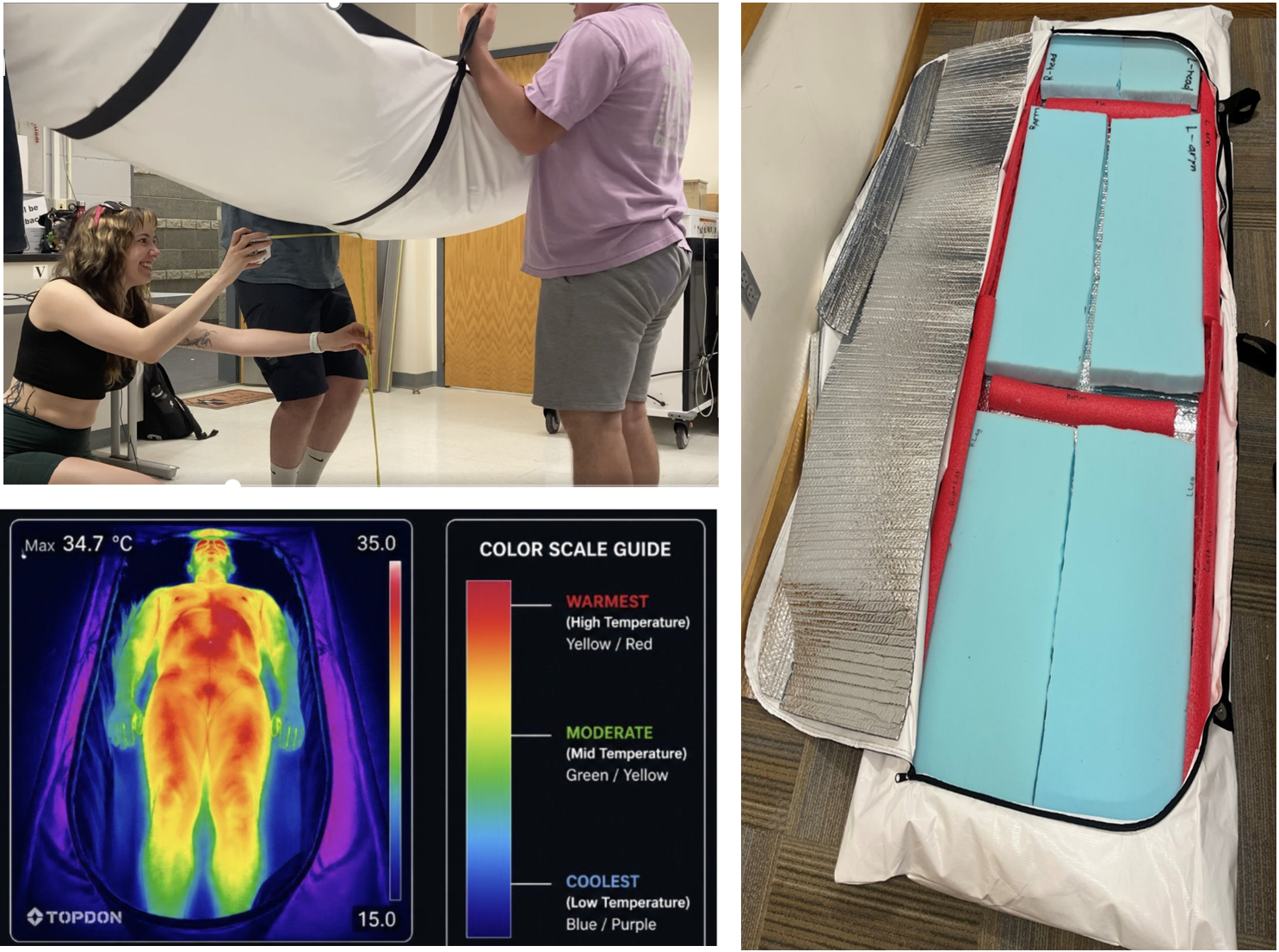
Presenter Group One [2:00pm-2:30pm]
Title: Let It Go: Innovative Body Bag Modifications for Impact and Temperature Regulation (Postmortem Artifacts Mitigation)
Presenters: Steve Navarro and Jessah Rylant
Biographies: Steve Navarro is a Criminal Justice major at Salt Lake Community College (SLCC) in their sophomore year, who aspires to become a Medicolegal Death Investigator (MDI) with the Utah Medical Examiner’s Office. He completed two forensic science courses and a Capstone Research Project, and also competed in both the SLCC Regional and State SkillsUSA Crime Scene Investigation (CSI) team competitions, placing third. He intends to complete additional coursework at SLCC thanks to his SkillsUSA scholarship before transferring to Utah Valley University (UVU) to pursue a B.S. in Forensic Sciences with a Field Investigation Emphasis. Jessah Rylant is a Criminal Justice major at Salt Lake Community College (SLCC) in their sophomore year who aspires to become a Forensic Scientist. They have completed two forensic science courses and a Capstone Research Project, and also competed in both the SLCC Regional and State SkillsUSA Crime Scene Investigation (CSI) team competitions, placing second. They intend to complete additional coursework at SLCC thanks to their SkillsUSA scholarship before transferring to another institution to pursue a B.S. in Forensic Sciences.
Abstract: Postmortem artifacts are changes or features that happen in a body after death that can cause misinterpretation of evidence during autopsies. It often is created during decedent transport and can complicate autopsies by simulating ante/peri- mortem (before/at or around death) injuries or altering evidence important to medicolegal death investigations. This project explored whether an innovative body bag modification could improve preservation during transport by reducing temperature fluctuations as well as minimizing transport-related impacts that could result in postmortem (after death) injuries. The modified bag was lined up with upholstery foam, Reflectix insulation material (found in hardware stores), and foam pool noodles secured with Velcro to provide cushioning and regulate temperature. To see how effective those changes were, both the modified and unmodified body bag underwent two controlled tests. The impact test was performed through drop tests at varying heights equivalent to that of typical transport stretchers using force plate analysis. Force plate analysis in a drop test involves measuring the force that a mannequin experiences while falling at varying heights. Whereas temperature fluctuations were assessed with mannequins, simulating decedents recovered from temperature-controlled environments as well as hypothermic (cold) ones. Said mannequins were placed on a gurney inside an ambulance to simulate ambient transport conditions for one-hour long intervals with temperature data loggers placed in multiple locations. Results were then compared to determine whether that modified design performed better than the traditional unmodified body bag. This research will improve both body bag designs and transportation practices for law enforcement, forensic personnel, medical examiners and mortuary staff. This will ensure the integrity of evidence and PMI estimates and lower transportation-related artifacts from being misinterpreted during autopsy.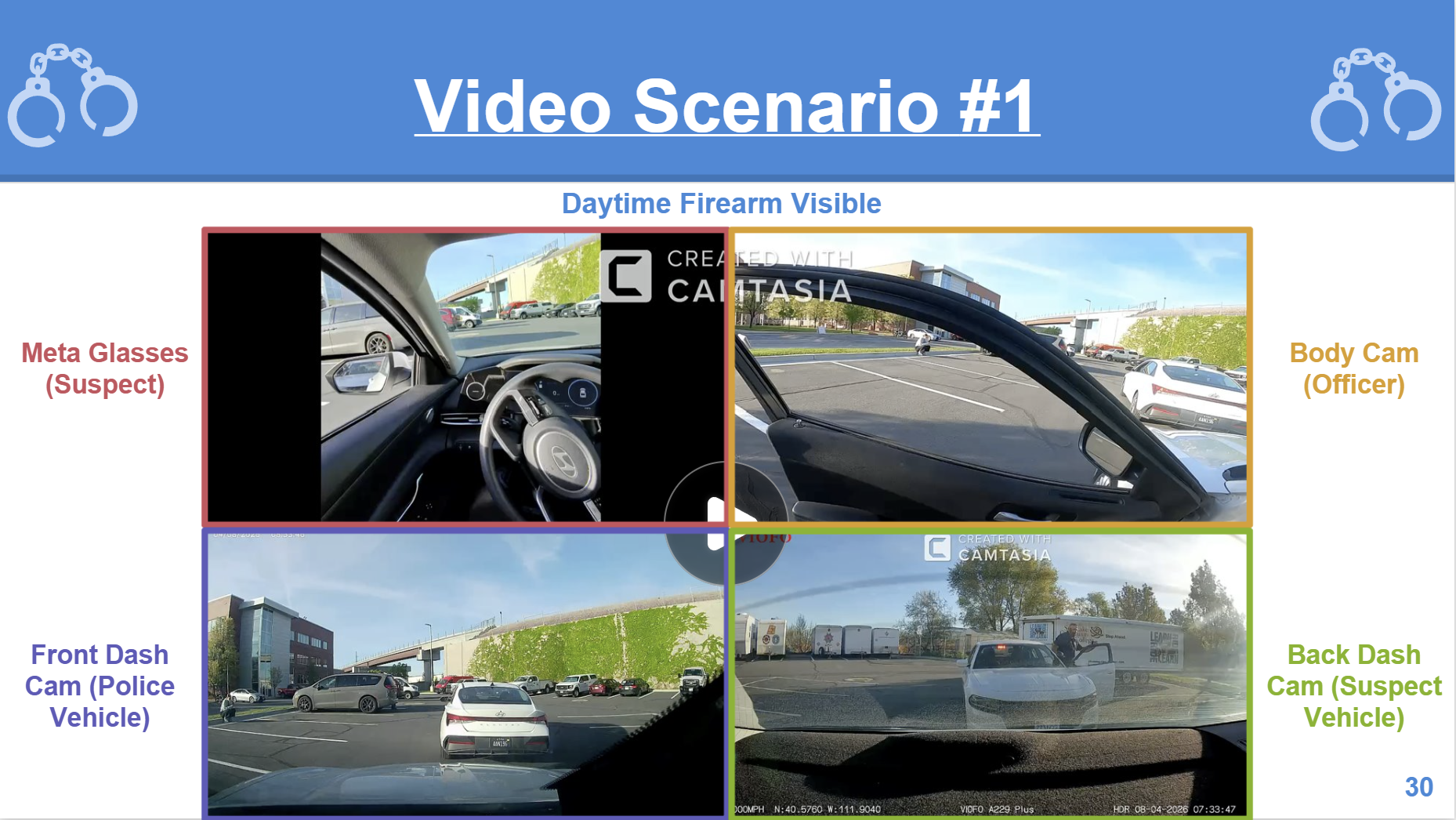
Presenter Group Two [2:30pm-3:00pm]
Title: Seeing Can Be Deceiving: Camera Type, Settings, and Perspective Assessments
Presenters: Maria Gallardo, Lucy Herrold, and Whitney Romig
Biographies: Maria Gallardo is currently a Criminal Justice major at Salt Lake Community College (SLCC), who aspires to become a Victim Advocate. Maria has gained hands-on experience through two forensic courses, a group Capstone Research project, and an internship with the Department of Veterans Affairs in the Victim Services Department, along with coursework focused on advocacy and trauma-informed care. She intends to continue her education by pursuing a bachelor’s degree in a related field. Lucy Herold is currently a Criminal Justice major at Salt Lake Community College (SLCC) in her sophomore year, who aspires to become a Forensic Psychologist. She has deepened her understanding of forensics by completing three forensic science courses at SLCC, a group Capstone Research project, and competing in Skills USA Crime Scene Investigation (CSI) competitions for the past three years at the secondary and post-secondary levels. She intends to transfer to Utah Valley University (UVU) to pursue a B.S. in Psychology in Fall 2027. Whitney Romig is currently a Criminal Justice major at Salt Lake Community College (SLCC) in her sophomore year, who aspires to become a Crime Scene Investigator (CSI). She has gained extensive hands-on experience through an internship with the South Salt Lake Police Department, SkillsUSA Crime Scene Investigation (CSI) competitions, along with coursework in three different forensic science classes and a group Capstone Research project. Whitney intends to transfer to Utah Valley University (UVU) to pursue a B.S. in Forensic Sciences with a Forensic Investigation Emphasis in Spring 2027.
Abstract: What if what you think you saw is not what actually happened? In criminal investigations, video footage is often treated as objective truth, but camera perspective (camera angle, lighting, resolution, and movement) can significantly influence what details, actions, and context are captured or missed. This Capstone Research project examined how different camera types (body-worn cameras, dash cameras, surveillance systems, and smartphones) compare to human perception during real-world scenarios. It was hypothesized that camera angle, placement, and lighting conditions as well as camera quality and field of view would affect what details are captured and could lead to differences between what a person observed and experienced versus what a camera recorded. To test this, multiple “mock” scenarios were created and assessed, including: traffic stops (with and without a weapon, including a phone), driving while intoxicated (DWI), a foot pursuit, and a burglary. Each scenario was recorded using multiple cameras, including body-worn cameras (BWCs), dash cameras, surveillance cameras (including Ring doorbells), and smartphones. Recordings were conducted in both daylight and nighttime conditions. Survey questions were also developed and will be completed by different audiences to compare how participants interpreted the events based on different cameras, perspectives, and personal backgrounds. Preliminary findings suggest that camera perspective can limit visibility, alter depth perception, and influence how events are interpreted by viewers, sometimes causing important details to be overlooked, distorted, or misinterpreted due to blind spots, motion blur, or limited field of view. These results highlight that video evidence does not always provide a complete representation of an event. Overall, this study demonstrates the importance of carefully analyzing camera footage by trained investigators, forensic video analysts, and legal professionals alongside human perception and other forms of evidence. This research helps improve how video evidence is understood and interpreted in criminal investigations. By showing the limitations of camera perspective along with factors such as lighting, angle, and recording quality, this study can help investigators, attorneys, and juries make more informed decisions when reviewing footage. It also highlights the need to consider multiple perspectives rather than relying on a single video source.
*5 min. Q&A period after each 25 min. student presentation
Session Five
3:00pm – 4:00pm
Room 1 (Zoom Streaming): PSET 219
Innocence Projects: The Devastating Implications of Wrongful Convictions
Chair: Antonette Gray, Associate Professor, Salt Lake Community College (SLCC)
Presenter One [3:00pm-3:20pm]
Title: Innocence Project Case: Anthony Wright
Presenter: Lauren Anderson
Biography: Lauren Anderson is a Criminal Justice Major in their sophmore year at Salt Lake Community College (SLCC). Lauren is unsure of what career path to take, but intends to transfer to Weber State University in Fall 2026 to complete their Bachelor’s Degree.
Abstract: Anthony Wight was wrongfully convicted of Rape, First-Degree Murder, Burglary, and Robbery and was sentenced to life in prison on June 8th, 1993, in Pennsylvania. They served 25 years due to the following contributing causes: witness testimony, a confession, and physical evidence. Thankfully, they were exonerated by DNA evidence being retested. The real perpetrator was Ronnie Byrd. It is important to learn about this case to bring more awareness to cases like this, as well as those who are wrongfully convicted. With knowledge of this, we can have better education and seek justice and more protection for defendants and their rights. This can later prevent some potential wrongful convictions from happening.
Presenter Two [3:20pm-3:40pm]
Title: Innocence Project Case:
Presenter:
Biography:
Abstract:
Presenter Three [3:40pm-4:00pm]
Title: Innocence Project Case: Rosa Jimenez
Presenter: Natalie Vierig
Biography: Natalie Vierig is a Criminal Justice Major in their sophomore year at Salt Lake Community College (SLCC). Natalie aspires to become an Administrator at a corrections facility and intends to transfer to UVU in Fall 2026 to complete their B.S. in Criminal Justice.
Abstract: Rosa Jimenez was wrongfully convicted of Injury to a Child, and Felony Murder and was sentenced to 99 years on August 31st, 2005, in Texas. They served 17 years due to the following contributing causes: biased medical testimony and lack of DNA. Thankfully, they were exonerated by other means. There was no real perpetrator, and this was a tragic case of a 21-month-old boy choking. This case is important because we need to hold medical professionals accountable for providing biased testimony. It is also important to understand that we need to make sure defendants have proper legal counsel to help defend them. Rosa did not commit a crime, as Judge Karen Sage stated she was innocent all along.
*5 min. Q&A period after each 15 min. student presentation
Room 215:
Chair: Anthony J. Nocella II
Presenter One:
Title:
Presenter: Tatiana Barrezueta
Biography:
Abstract:
Presenter Two:
Title:
Presenter: Jennifer Falstad
Biography:
Abstract:
Presenter Three:
Title:
Presenter: Gabby Guercio
Biography:
Abstract:
Presenter Four:
Title:
Presenter: Kanisha Kim
Biography:
Abstract:
Presenter Five:
Title:
Presenter: Emma Mower
Biography:
Abstract:
Presenter Six:
Title:
Presenter: Sean Nydegger
Biography:
Abstract:
Presenter Seven:
Title:
Presenter: Vanessa Santiago
Biography:
Abstract:
Presenter Eight:
Title: Preventing Parent-Child Abuse at Home
Presenter: Aleksandar Saran
Biography: Aleksandar Saran is a student at Salt Lake Community College. He is majoring in
Criminal Justice and hopes to become a police officer in Salt Lake City, Utah. He was born and
raised in Salt Lake City, Utah. His parents moved here from Belgrade, Serbia, to escape the war
in Serbia. He developed an interest in Law enforcement when he was in high school after taking
a Law enforcement class.
Abstract: Child abuse within the home is a serious and ongoing social issue that affects millions of
children each year. It includes physical, emotional, and sexual abuse, as well as neglect, all of
which can have lasting impacts on a child’s development and well-being. This paper explores
child abuse as a social problem by examining its causes, including family stress, economic
hardship, and cycles of violence. It also discusses the long-term effects on victims, such as
mental health issues, behavioral problems, and difficulty forming relationships. Understanding
these factors is important to raise awareness and improve prevention efforts. Addressing child
abuse requires both community involvement and stronger support systems for families at risk.
Presenter Nine:
Title: Government Corruption and money
laundering
Presenter: Alondra Calata Ramirez
Biography: Alondra Calata Ramirez is a twenty-one year old college student at Salt Lake
Community College. Alondra is majoring in Criminal Justice and is still deciding what career
she wants to follow in the Criminal Justice System. Alondra grew up in Mexico during her whole
middle childhood and moved into the United States in her childhood. It’s been a really hard
journey for Alondra but she has come along. Most of the time Alondra can be found at her house
enjoying time with her family or at work working for her dreams to come true.
Abstract: Corruption is a big problem in our country that is associated with money laundering
disturbing the economy for all those residents of the country while we think corruption can only
be found in our Federal Government, we can also find corruptions in many places that we would
of have never thought; schools, public services, government offices, business, workplaces etc.
This topic has been brought to my attention because as the economy grows and grows it seems
like we are still stuck in the same place for some reason and even wonder why? Corruption is the
answer. This presenation will explain to us a bit more about corruption, types of corruptions, how
it affects us and why it is important to start making changes.
Presenter Ten:
Title: Immigration Enforcement Bias and Its Contribution to Mass Incarceration in the United
States
Presenter: German Andres Tirado Oviedo
Biography: German Andres Oviedo is a 30-year-old college student from Colombia. He moved to the US to
continuo his athletic career in speed skating at the age of 23, so far, she has been in the US for
almost seven years. After formally retiring from competition, German Oviedo majored
Construction Management and Fitness Technician at Salt Lake Community College.
He grew up in Utah and has been actively involved in both academic studies and professional
work within construction and business. In his free time, he enjoys working on real estate
projects, training, and spending time with his adorable daughter.
Abstract: Immigration enforcement in the United States has increasingly become intertwined with
the criminal justice system, leading to significant concerns regarding bias and systemic
oppression. This paper examines how immigration enforcement practices disproportionately
target marginalized communities, particularly Latino and undocumented populations, and how
these practices contribute to mass incarceration. The expansion of federal enforcement agencies,
cooperation between local law enforcement and immigration authorities, and the criminalization
of immigration-related offenses have intensified these disparities. As a result, many individuals
are detained and incarcerated for nonviolent offenses, often under harsh conditions that mirror
the broader prison system. This paper also analyzes the causes behind immigration enforcement
bias, including political narratives, racial profiling, and institutional incentives. Additionally, the
paper explores the social and economic consequences of these practices, such as family
separation, community distrust, and long-term marginalization. Through a critical thinking
framework, this study highlights the structural inequalities embedded within immigration
enforcement and emphasizes the need for reforms that prioritize justice, fairness, and new paths
to citizenship.
5 to 10 minutes for Q and A
Room 4: PSET 278
Innocence Projects: The Devastating Implications of Wrongful Convictions
Chair: Stephanie L. Hoffman, Associate Professor, Salt Lake Community College (SLCC)
Presenter One [3:00pm-3:20pm]
Title: Innocence Project Case: John Nolley
Presenter: Binti Mohamed
Biography:
Abstract:
Presenter Two [3:20pm-3:40pm]
Title: Innocence Project Case: Paula Gray
Presenter: Helena Billings
Biography: Helena Billings is a Criminal Justice Major in their sophomore year at Salt Lake Community College (SLCC). Helena aspires to become a Crime Scene Investigator (CSI) and intends to transfer to Utah Valley University in Fall 2026 to complete their B.S. in Forensic Science.
Abstract: Paula Gray was wrongfully convicted of Rape, First-Degree Murder, and Perjury and was sentenced to 50 years of imprisonment on October 20th, 1978 in Illinois. They served 9 years due to the following contributing causes: faulty testimonies, deals made with prosecution, no corroboration with forensic evidence, one testimony never handed to the defence, and exploitation of a disabled person. Thankfully, they were exonerated by recanted testimonies, proper forensic science done later, and journalism students discovering the testimony never given to the defense. The real perpetrators were identified. This case is crucial because it showcases evidence mishandling when it came to a disabled suspect and not making the information of their disability as well as what that could mean when it came to the events they supposedly witnessed/participated in, known to the jury, and how, if we take the proper precautions needed when interrogating someone with a disability, it could lead to less people falsely incarcerated.
Presenter Three [3:40pm-4:00pm]
Title: Innocence Project Case: Paul House
Presenter: Hailey Hess
Biography: Hailey Hess is a Criminal Justice Major in their freshmen year at Salt Lake Community College (SLCC). Hailey aspires to become a Forensic Science Technician and intends to transfer to Utah Valley University in 2027 to complete their B.S. in Forensic Sciences.
Abstract: Paul House was wrongfully convicted of Murder and was sentenced to death in February 1987 in Union County, TN. They served 22 years due to the following contributing causes: he was a neighbor of the deceased, and had blood on his jeans suspected of matching the murder victim. There was also semen found on the victim, matching Paul House’s blood group. Most of the reasons he was charged were due to inadequate defense, and unvalidated or improper forensic science. Thankfully, he was exonerated by retesting the DNA evidence, which showed his innocence. The real perpetrator has yet to be identified. It is incredibly important to know and learn about this case, because it shows the effect that improper handling and unvalidated forensic science can have on a case, putting an innocent man behind bars for 22 years. When it comes to testing evidence from forensic technicians, the evidence needs to be tested and handled correctly. Wrong information can put innocent people behind bars.
*5 min. Q&A period after each 15 min. student presentation
Session Six
4:00pm – 5:00pm
Room 1 (Zoom Streaming): PSET 219
Innocence Projects: The Devastating Implications of Wrongful Convictions
Chair: Antonette Gray, Associate Professor, Salt Lake Community College (SLCC)
Presenter One [4:00pm-4:20pm]
Title: Innocence Project Case:
Presenter:
Biography:
Abstract:
Presenter Two [4:20pm-4:40pm]
Title: Innocence Project Case:
Presenter:
Biography:
Abstract:
Presenter Three [4:40pm-5:00pm]
Title: Innocence Project Case: Greg Kelley
Presenter: Teresita Ramirez
Biography: Teresita Ramirez Lopez is a Criminal Justice Major in their sophomore year at Salt Lake Community College (SLCC). Teresita aspires to become a Police Officer.
Abstract: Greg Kelley was wrongfully convicted of two counts of Indecency With a Child and two counts of Super Aggravated Sexual Assault was sentenced to 25 years on July 16, 2014 in Texas. They served 3 years due to the following contributing causes: extensive errors in the investigation and prosecution, including how authorities failed to question other people around the children at the time and, how Kelley’s original lawyer had a conflict of interest because of her friendship with the McCarty family. Thankfully they were exonerated, but the real perpetrator has yet to be identified. It is important to learn that physical evidence is vital and should be relied upon rather than assumptions. When a child is interviewed, it is also important to pay close attention to their statements and the line of questioning, as they may be prone to manipulation.
*5 min. Q&A period after each 15 min. student presentation
Room 4: PSET 278
Innocence Projects: The Devastating Implications of Wrongful Convictions
Chair: Stephanie L. Hoffman, Associate Professor, Salt Lake Community College (SLCC)
Presenter One [4:00pm-4:20pm]
Title: Innocence Project Case: George Allen
Presenter: Lynx Starr
Biography: Lynx Starr is a Criminal Justice Major in their sophomore year at Salt Lake Community College (SLCC). Lynx aspires to become a Sexual Violence Victim Advocate and intends to transfer to Southern Utah University in Spring 2027 to complete their B.S. in Sociology.
Abstract: George Allen Jr. was wrongfully convicted of Capital Murder, Burglary of the First Degree, Rape, and Sodomy and was sentenced to 95 years on July 25, 1982 in Missouri. They served 30 years due to the following contributing causes: false admissions, government misconduct, and improper forensic science. Thankfully, they were exonerated by the discovery of DNA evidence that initially went undisclosed to the defense, which eliminated him as a suspect. The real perpetrator has yet to be identified. It is important to learn from this case due to the extreme case of police tunnel vision and the mishandling of a mentally ill individual, which it displays.
Presenter Two [4:20pm-4:40pm]
Title: Innocence Project Case: Kirk Bloodsworth
Presenter: Elijah Nelson
Biography: Elijah Nelson is a Criminal Justice Major in his sophomore year at Salt Lake Community College (SLCC). Elijah aspires to become a Federal Law Enforcement Officer and intends to transfer to Southern Utah University in Fall 2026 to complete his B.S. in Criminal Justice.
Abstract: Kirk Bloodsworth was wrongfully convicted of First-Degree Murder, First-Degree Rape, and First-Degree Sexual Offense and was sentenced to death on March 8, 1985, in the state of Maryland. He served approximately 9 years in prison, including 2 years on death row, due to the following contributing causes: eyewitness misidentification, investigative tunnel vision, and official misconduct such as withholding exculpatory evidence. Thankfully, he was exonerated by DNA testing in 1993, which proved that biological evidence from the crime scene did not match him. The real perpetrator was identified as Kimberly Shay Ruffner through DNA database evidence and was later convicted. It is important to study this case because it demonstrates how easily the criminal justice system can convict an innocent person, even in a death penalty case. The Bloodsworth case highlights the importance of forensic science, especially DNA testing, in ensuring justice and preventing wrongful convictions.
Presenter Three [4:40pm-5:00pm]
Title: Innocence Project Case: Anthony Ray Hinton
Presenter: Briseyda Leal
Biography: Briseyda Leal is a Criminal Justice major in her sophomore year at Salt Lake Community College (SLCC). Briseyda aspires to become a Criminal Profiler and intends to transfer to a university in Fall 2026 to complete their B.S. in Criminal Justice.
Abstract: Anthony Ray Hinton was wrongfully convicted of two counts of Murder and was sentenced to death in 1985 in Alabama. He served nearly 30 years on death row due to contributing causes such as: unreliable forensic evidence, improper expert testimony, and inadequate legal defense. The prosecution’s case relied mostly on a flawed ballistics analysis that incorrectly claimed bullets from the crime scenes matched a gun found in Hinton’s home. In 2015, he was exonerated after attorneys from the Innocence Project reexamined the evidence and proved that the forensic testimony used at trial was inaccurate and misleading. Independent experts confirmed that the bullets could not be reliably linked to Hinton’s firearm. The real perpetrator has yet to be identified. It is important to learn about this case and many others like it because it highlights how errors in forensic science and the justice system can lead to devastating consequences. Cases like Hinton’s show the need for stronger forensic standards, better legal representation, and accountability within the criminal justice system to prevent wrongful convictions in the future.
*5 min. Q&A period after each 15 min. student presentation
Session Seven
5:00pm – 6:00pm
Room 4: PSET 278
Innocence Projects: The Devastating Implications of Wrongful Convictions
Chair: Stephanie L. Hoffman, Associate Professor, Salt Lake Community College (SLCC)
Presenter One [5:00pm-5:20pm]
Title: Innocence Project Case: Peter Joseph Rose
Presenter: Nathaniel Castro
Biography: Nathaniel Castro is a Criminal Justice Major in their sophomore year at Salt Lake Community College (SLCC). Nathaniel aspires to become a Police Officer and intends to transfer to Utah Valley University next year to complete their B.A. in Criminal Justice.
Abstract: Peter Joseph Rose was wrongfully convicted of Rape and Kidnap and was sentenced to 27 years in 1995 in Lodi, California. They served nearly 10 years due to the following contributing causes: a false identification, a coerced statement, and a lack of due process in court. Thankfully, they were exonerated by the California Innocence Project using DNA testing. The real perpetrator has yet to be identified. The Peter Rose case is a classic example of how many things could go wrong at once and how we can learn from it to ensure no other wrongful convictions ever take place.
Presenter Two [5:20pm-5:40pm]
Title: Innocence Project Case:
Presenter:
Biography:
Abstract:
Presenter Three [5:40pm-6:00pm]
Title: Innocence Project Case:
Presenter:
Biography:
Abstract:
*5 min. Q&A period after each 15 min. student presentation
6:00pm – End of Conference
![Official Statement – Save the Kids Official Statement on the organization – Save The Children [Fund]](https://savethekidsgroup.org/wp-content/uploads/2019/11/Save-the-Kids-Official-Statement-header.jpg)