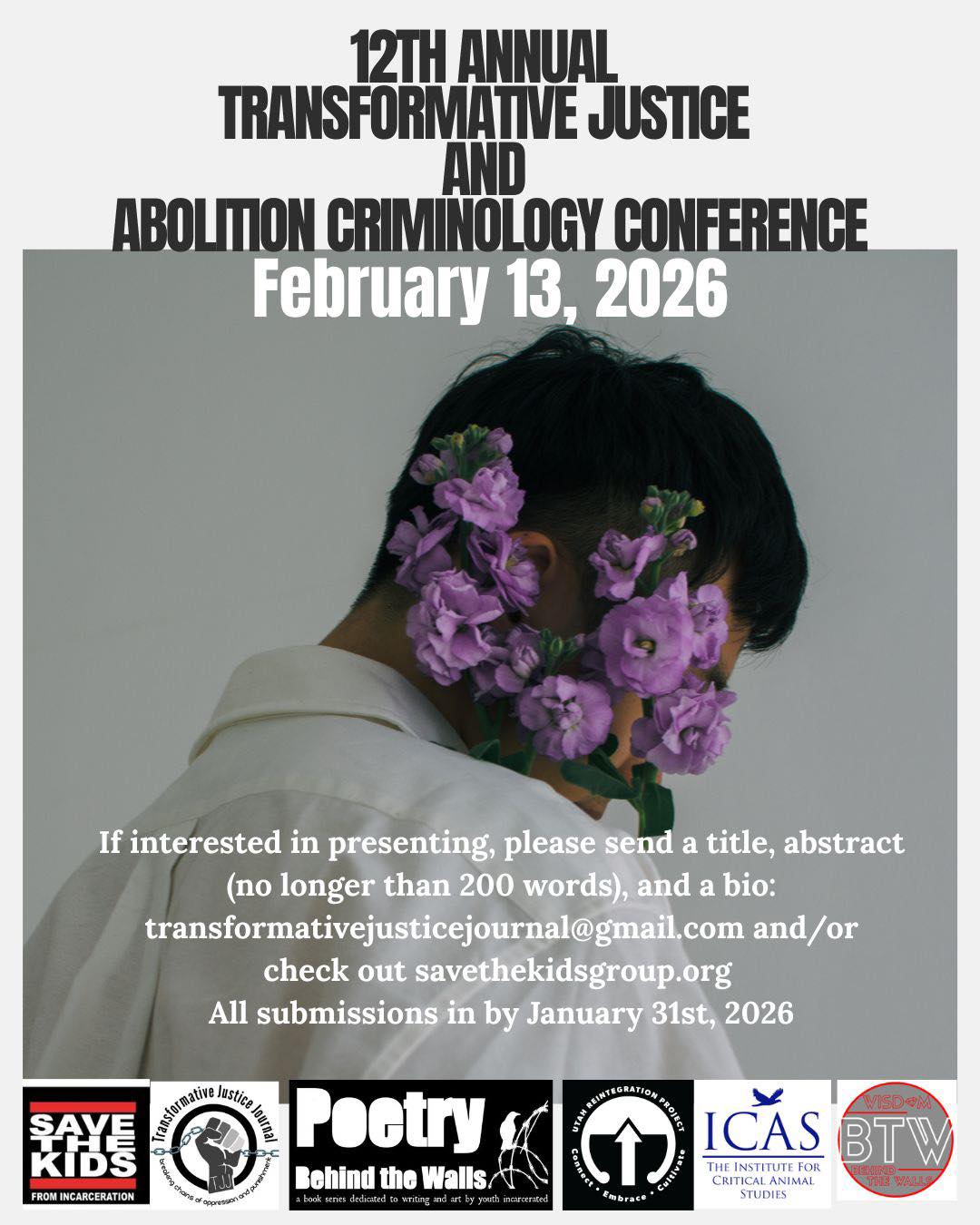
February 13, 2026
12th Annual Transformative Justice and Abolition Criminology Conference
9:00am to 5:10pm (Western Time USA)
10:00am to 6:10pm (Mountain Time USA)
11:00am to 7:10pm (Central Time USA)
12:00pm to 8:10pm (Eastern Time USA)
Via Zoom, Public, Free, and Recorded
Register Here:
https://slcc-edu.zoom.us/meeting/register/PAnZzL7xSKeUzL1hnajXtg
Co-Conferences Chair:
Lucas Alan Dietsche
lucasdietsche81@gmail.com
Dr. Lea Lani Kinikini
Lkinikini@gmail.com
INTERESTED THEMES:
Transformative Justice
Critical disability studies
Healing Justice
Prison Abolition
Cultural and Religious intersectionalities
Language Terminology
Policy and/or/versus Culture Social Change
Social and Cultural Construction of Disabilities
Fighting Political and Corporate Repression
Being a Scholar-Activist
Decolonizing Movements and Education
Hip Hop Pedagogy, Activism, and Studies
Rhetoric of Health and Wellness
Social Attitudes of Neuroatypicality
Total Liberation
Anti-Capitalism
Racial Justice
Economic Justice
Social Justice
Youth Justice
Critical Eco-Feminism
LGBTTQQIA+ Justice
Mediation
Community Justice and Circles
Direct Democracy
Critical Criminology
Community Organizing
Anarchist Criminology
Radical Criminology
Peace Studies and Making
Conflict Transformation and Resolution
All Speakers have 20 minutes to present with 10 minutes of questions and comments.
SUBMIT
All submissions for the conference need to be in a Word Doc. as an attachment in an E-mail with the following information:
1. Title of Presentation
2. Biography third person 80 to 100 words one paragraph
3. Description/Abstract of the presentation around 200 words third person and one paragraph
SEND SUBMISSION TO: Lucas Dietsche lucasdietsche81@gmail.com
Deadline is passed for submissions.
SCHEDULE
(Based on USA Mountain Time)
10:00am – 6:10pm
1). 10:00am – 10:10am – Welcoming and Introduction by Co-Chairs
Lucas Alan Dietsche
Biographies: Lucas Alan Dietsche (He, Comrade, Accomplice) is a National Director of Transformative Justice and member of the Division of Convict Criminology. He is a PhD student in Philosophy, Aesthetics, and Theory with a Masters in Criminology researching Poetic Inquiry, zines, taphology, carceral feminism, and Marxist feminist abolition. He is a Guest Lecturer at the Univeristy of Muri. Dietsche is adjunct professor of Prisoner Education of Adams State University. He was Superior, Wisconsin first Co-Poet Laureate. Dietsche is the co-campagin manager for Gladis the Orca for Governor of Minnesota-2026. Dietsche has recently published a book on radical Comoros and won the Lived Experience Storyteller Award.
Dr. Lea Lani Kinikini
Dr. Lea Lani Kinikini (she/her/ia) is a critical cultural researcher whose learning interests include family migration, diaspora (especially Oceanic and Pacific Islander), popular culture and gender (including youth and masculinity), and community power relations focused on class, race and spirituality/religion. She currently is the director of research and engaged scholarship at University of Hawai’i.
2). 10:10am – 10:30am – Inventing the Enemy Within: ‘Trantifa’ and the Long History of Policing Gender Nonconformity in U.S. Security Regimes
Presenter: Zane McNeill
Biography:
Zane McNeill is the co-author of The Coercive Power of the Law: Vulnerable Bodies and Boundaries of Perception (Palgrave, 2025). He has a MA from Central European University and a JD from University of Denver Sturm College of Law.
Abstract:
Law and technology are often treated as distinct domains, yet surveillance reveals their deep entanglement as tools of coercive state power. In the United States, surveillance has long targeted populations constructed as threats to the nation, including Black liberation movements, queer communities, and other racialized and gendered Others. Transgender people are not newly drawn into this framework; rather, trans bodies have long been governed through criminalization, medicalization, and surveillance that render them hyper-legible to the law.Using discourse analysis, this presentation examines how contemporary anti-trans rhetoric—particularly the term “trantifa”—reactivates familiar legal and political logics that align gender nonconformity with anti-Americanism, extremism, and terrorism. Situating recent developments such as the Trump Administration’s NSPM-7 designation of “extremism on gender” within a longer history of federal surveillance from COINTELPRO to the post-9/11 security state, the paper argues that these rhetorics function as technologies of anticipatory criminalization. Drawing on theories of coercive legal power, it contends that governing gender through terror frameworks reproduces long standing forms of ontological and racialized violence.
10:30am – 10:40am Q and A
3). 10:40am – 11:00am-“The Architecture of Temporal Violence in Carceral Systems”
Presenter: Justin Gallant
Biography:
Justin Gallant is a PhD student at the Institute for Doctoral Studies in the Visual Arts (IDSVA) and an adjunct professor of philosophy with Adams State University. His research focuses on post-reality temporalities, political alternatives, and metastable systems, with particular emphasis on recursion, collapse, and recombination as structural conditions rather than exceptions. Drawing on continental philosophy, media theory, and contemporary art, his work examines control assemblages through temporal ecology governed by preemption, indeterminacy, and recombinatory memory. Gallant’s research is developed through theoretical writing, artistic analysis, and field-based archival methods that foreground structural honesty over resolution.
Abstract:
Carceral systems are often analyzed as regimes of spatial confinement, yet one of their most pervasive forms of violence operates through time. This presentation argues that prisons function as temporal machines that discipline subjects by manipulating perception, rhythm, and agency. Through regimented schedules, enforced waiting, deprivation of natural cues, and arbitrary interruption, carceral systems enact chronometric domination—compressing, elongating, and removing time as a means of control. This paper gives particular attention to solitary confinement as an extreme form of temporal weaponization, where isolation collapses social and sensory time, forcing the mind to generate temporal structure under punitive conditions. This helps explain why solitary confinement constitutes torture beyond physical harm. By reframing incarceration as temporal violence, the presentation argues that abolition must address not only spatial enclosure but the restoration of temporal agency. Liberation, in this frame, requires dismantling the architectures of time that render captivity governable, normalized, and invisible.
11:00am-11:10am Q and A
4). 11:10am-11:20am- Writing Across Confinement: Transformative Justice, Zine-Making, and Collective Authorship
Presenter: Mx. Je’Jae C. Mizrahi
Biography: Mx. Je’Jae C. Mizrahi is a Temani-Queer Millenial writer in nyc & has written for several publications & literary magazines: The Village Voice, Sold Magazine, Bluffton University, HuffPost, Pen America, Hey Alma, Lilith Magazine, S.I Advance , The Feminist Daily, Washington Square News, Fluide Beauty, Next Magazine, Jerusalem Post & Centro Voices of Center for Puerto Rican Studies at Hunter College. They have held residencies at Pen America “Dream Out Loud” of emerging migrant voices, National Queer Theatre’s “Write It Out”, Still Here fellowship in San Francisco partnership with L.A Times. The Tab at City University of New York
Abstract:This convening draws on my experience as a teaching artist and writer-in-residence with the Brooklyn Public Library’s Criminal Justice Initiative, Bridges Zine. Through this program, I collaborate with formerly incarcerated writers to support the creation and publication of original work grounded in truth-telling, accountability, and imagination. The collective zine circulates throughout New York’s carceral system, carrying stories, art, and critical reflection across prison walls and into shared public space. This practice situates writing as both aesthetic and relational labor—one that resists isolation by redistributing voice and cultivating dialogue between those inside and outside systems of confinement. Grounded in the principles of transformative justice, the work emphasizes narrative repair, mutual recognition, and the reconfiguration of authorship as a collective, ethical act rather than an individual achievement
11:20am-11:30am Q and A
5). 11:30am-11:50am-Building Community and Teaching Collectivism: Autoethnographic Reflections on Interrogating Individualism within the Classroom
Presenter: Dr. Katherine Brown
Biography: Dr. Katherine E. Brown is a critical criminologist/victimologist and trauma informed sociologist that seeks to center those with lived experience and people on the margins while decentering normative power structures. As a crimes of the powerful scholar, Brown historically has examined the intersection of systemic inequality and state sanctioned victimization, calling into question the role of the government in what it means to develop comprehensive, non-harmful legislation. Informed by Black feminist thought and the work of other scholars of color, her most recent scholarship examines 1) the role of critical pedagogy in the classroom by engaging undergraduates in deconstruction work, and 2) exploring the role of community as a tool for addiction recovery.
Abstract: Abstract: Many undergraduate students, especially at primarily white institutions, enter classrooms prepared, taught, and encouraged to think about learning as an individual process (Tavares 2022). Society’s neoliberal agenda has made its way into the classroom through students’ channeling hyper-independence, competitiveness, and the “student as consumer” mindset (Ashby-King 2024). Indeed, distinct challenges arise and rich learning opportunities are lost when students struggle to rely on one another. As the current sociopolitical landscape demands collective action, and mutual aid, I look to wisdom from Black feminist, indigenous, and other communal thinkers to refine my pedagogy in hopes of encouraging moments of individualistic thought disruption among students.
11:50am-12:00pm Q and A
6). 12:00pm-12:20pm-Restorative Resurgence: Navigating Urban Activism and Non-Violent Resolution in a Post-Pandemic Landscape
Presenter: Christopher Malik Powers
Biography: Christopher Malik Powers is a long time advocate for non violent conflict resolution in New York North Carolina And Vermont. A writer and organizer Malik has been volunteering alongside social justice leaders from all demographics. From Beverly Little Thunder Lakota Preistess and Trama Healer and Mark Hughes of the Vermont Center for Racial Justice to Imam Khallid Griggs of the Community Mosque of Winston Salem and Ingram Bell of the Margerrtet Clinard Outreach Foundation in north Carolina to the Institute for Transforamtive Mentoring known as Conduit. Chris Malik is along time Alternatives to Violence project Facilitator and trainer for trainer and is currently coordinating the AVP Landing Strip East NewYork and Brownsville Brooklyn.
Abstract:This work explores the evolution of national organizing strategies centered on restorative justice and urban affairs, tracing how movements have adapted to profound disruptions in social life and political action. It examines a pivotal methodological shift from the pre-COVID era—largely defined by in-person meetings, marches, and geographically bounded coalitions—to post-COVID frameworks that rely on digital-physical hybridity. Within these hybrid models, online platforms are not merely tools for communication but active sites of organizing, mutual aid, and collective imagination.The analysis foregrounds how activists have reconfigured notions of presence, accountability, and care, sustaining community cohesion despite physical distance and institutional precarity. By attending to virtual assemblies, distributed leadership, and data-driven advocacy alongside renewed forms of embodied action, the work shows how restorative justice practices have been recalibrated to address urban inequalities intensified by the pandemic. Ultimately, it argues that these hybrid strategies have expanded the temporal and spatial reach of organizing, enabling movements to translate community-based ethics into durable legislative and policy interventions at local and national scales.
12:20pm-12:30pm Q and A
7). 12:30pm-12:50pm-Arting and Tojisha Kenkyu
Presenter: Iris Arcus
Biography: Iris Arcus is an artist-historian, currently unhoused and residing safely among anti-capitalist, anarchist, community-focused humans of compassion. Iris teaches university courses online and she is an active practicing artist. Iris has a BFA in photography, and two MAs in photography and art history. Iris’s current practice integrates autoethnography and scholarly research with photographic processes, mixed media and assemblage of found or recycled objects to explore autistic phenomenology, the body, and women’s issues.
Abstract:Tojisha Kenkyu (“TK”) began in Japan in 2001 as a non-coercive, peer-led therapy for individuals with serious psychiatric conditions to explore and articulate their lived experiences in their own words, rather than in diagnostic labels. It has since expanded into more generalized use in Japan, including as a method of scientific inquiry into autism (Kumagaya, 2009). Remarkably, TK has yet to be explored in creative realms, leading me to ask: can TK be a form of Arting? By Arting, I mean not only the immediate action of creating a work of art, but art as praxis integrated into daily life. This presents how I have successfully used TK for creative practice and, more importantly, argues for TK’s potential as a form of art therapy, especially for so-called “neurodivergence”. TK is inherently aligned with the values and goals of social and transformative justice, and thus, TK art therapy can and should be studied as an option to incarceration for people with mental health challenges. To demonstrate, I will give a brief background on traditional TK, its resonance to social justice, and outline my experience Arting with TK, providing a case study of my work as further evidence.
12:50pm-1:00pm Q and A
8). 1:00pm-1:20pm-Promising Practices to Mitigate the Effects of Maternal Incarceration
Presenter: Lisette B. Hughes
Biography: Lisette B. Hughes is an educator, scholar, and advocate whose work centers on expanding access
to higher education for people impacted by incarceration. Her career spans program
management, curriculum design, and national advocacy, including roles with Hudson Link for
Higher Education in Prison, Columbia University’s Justice Lab, College and Community
Fellowship, and SUNY Columbia–Greene Community College.
Named a Champion of Change by the SUNY Office of Higher Education, Lisette has developed
and led initiatives that bridge education, reentry, and restorative leadership. She is currently
pursuing her Doctorate in Education at Hofstra University, where her research explores the
intersection of maternal incarceration, higher education, and children’s academic attainment.
In 2024–2025, Lisette launched The Restoration Tour: Voices of Women Rising After
Incarceration, a national speaking series highlighting women’s resilience, leadership, and
educational advancement. Through engagements in correctional facilities, universities, and
national conferences, she continues to champion education as a pathway to justice and
transformation.
Lisette holds a BA in Psychology and Spanish from Drew University and an MS in Early
Childhood Education, Childhood Education, and Students with Disabilities from Mercy
University. She lives by Nelson Mandela’s words: “Education is the most powerful weapon
which you can use to change the world.”
Abstract: This presentation examines promising practices that mitigate the intergenerational effects of
maternal incarceration, with particular attention to the role of higher education in prison (HEP)
as a stabilizing and transformative intervention. Research consistently demonstrates that children
of incarcerated mothers experience disruptions in caregiving, educational continuity, and
emotional security. However, emerging scholarship suggests that sustained parent–child contact,
caregiving stability, and maternal educational engagement can function as protective factors that
buffer harm and strengthen family outcomes. Drawing on a critical, abolitionist, and scholar-
activist framework, this session explores how educational access for incarcerated
mothers—paired with policies that support family connection—may interrupt cycles of
marginalization and expand pathways toward collective liberation.
Grounded in a broader dissertation project examining the relationship between maternal
participation in higher education during incarceration and children’s academic attainment, the
presentation synthesizes interdisciplinary research from criminology, education, and family
studies. It situates maternal education as both a site of resistance and a mechanism for structural
intervention, highlighting how HEP programs can serve as healing-justice practices that support
identity transformation, family stability, and intergenerational educational mobility. Attendees
will engage with emerging findings and policy implications that call for increased investment in
women’s educational programming and family-centered supports as part of a transformative
justice agenda.
1:20pm-1:30pm Q and A
9). 1:30pm-1:50pm-This Is Grief Too: The Unspoken Emotional Impact of Incarceration and Systemic Harm
Presenter:Ayana Thomas
Biography: Ayana Thomas is a certified grief support practitioner, author, and community-based facilitator with lived experience supporting women and families impacted by loss, trauma, and the criminal legal system. She is the founder of Grieving Back to Life and the creator of The Grief Behind the Gravel, a trauma-informed healing curriculum that addresses the emotional impact of incarceration, reentry, and systemic harm.Ayana’s work centers on naming and holding disenfranchised and compounded grief—losses of freedom, identity, family, safety, and possibility that are often overlooked in justice-impacted spaces. Her approach is culturally responsive, healing-centered, and grounded in both professional practice and lived experience. She facilitates workshops, groups, and learning spaces across community organizations, reentry programs, and women-centered initiatives, with a focus on emotional literacy, accountability, dignity, and restoration. Her work is rooted in the belief that healing is prevention and essential to lasting reform.
Abstract: Incarceration produces profound and often unacknowledged loss—loss of freedom, family connection, identity, safety, time, and possibility. Because these losses are rarely named as grief, they are frequently misinterpreted as behavioral problems, resistance, or risk.This Is Grief Too reframes incarceration-related loss as legitimate, disenfranchised grief. Drawing from trauma-informed practice, public-health frameworks, and lived experience, this session explores how unprocessed grief shows up in justice-impacted spaces and why healing-centered responses are essential to accountability, emotional regulation, and long-term stability.
1:50pm- 2:00pm Q and A
10).2:00pm-2:20pm Art Inside, hope, and Minnesota
Presenters: Roberto Lopez-Rios and Antonio Espinosa
Biography: Roberto Lopez-Rios is an artist whose work is rooted in resilience, survival, and hope. Born in Morelos, Mexico, he was raised in South Minneapolis, Minnesota fronced to life in prison. In May 2024, after 23 years, Roberto was released from prison, only to face deportation due to his immigration status. With the support of devoted friends and community, he has returned to Mexico and is now rebuilding his life through art. Roberto’s journey continues to inspire his daughter, family, and all those who believe in the power of creativity to transform lives.
Antonio Espinosa is the founder and Executive Director of Art from the Inside. Art From the Inside creates the opportunity for incarcerated artists to have a visual voice through engaging, community-centered exhibitions of their art. After serving for almost 20 years as a senior corrections officer at Stillwater state prison in Minnesota, Antonio launched this project to bring hope and healing inside the walls. While still in uniform, he co-facilitated men’s support groups, coordinated cultural events and served on advisory boards and committees for the Minnesota Department of Corrections. In 2021, he received a Bush Fellowship for his transformative work elevating the voices of the incarcerated through community-centered exhibitions of their art. In 2022, he became a policy fellow in the Humphrey School of Public Affairs and created a bill for supportive arts programming in Minnesota’s state prisons which was signed into law during the 2023 legislative session. He is driven to build toward a larger transformation in the justice system and in the community.m the age of three. Growing up surrounded by violence and instability, Roberto was pulled into street life at a young age, a path that disrupted his childhood and sense of direction. By fifteen, he was a father striving to create a better life for his daughter and had returned to school, rediscovering art as a source of purpose. That momentum was cut short when, at sixteen, he was arrested, tried as an adult, and sente
Abstract: This brings together Antonio Espinosa, a former correctional officer and co-founder of Art from the Inside, and Roberto Lopez-Rios, an artist who was incarcerated where Antonio worked and later deported due to his immigration status. Guided by facilitator Avra Anagnostis, the session explores their uncommon and evolving relationship as a living example of transformative justice in practice.Through dialogue, Antonio and Roberto reflect on their shared history within the carceral system, Roberto’s experience of incarceration and deportation, and the ways art became a tool for survival, expression, and healing amid displacement and isolation. The conversation examines how creative practice can interrupt carceral dehumanization, restore humanity, and create space for repair and love across power and positionality. Grounded in healing-centered frameworks, this session invites participants to consider how relationships formed within systems of harm can be transformed into sites of solidarity, storytelling, and collective meaning-making. By centering lived experience and art as knowledge, the conversation challenges dominant narratives of punishment and exclusion and offers insight into how creativity can support justice, dignity, and belonging beyond prison walls and borders.
2:20pm-2:30pm Q and A
11). 2:30pm-2:50pm- From Ireland to New Jersey: Navigating Tensions in Emancipatory Education and the Development of the Irish Penal Abolition Network (IPAN)
Presenter: Kathleen White
Bioegraphy: Kathleen White is a doctoral student at Rutgers University School of Criminal Justice with a focus on critical criminology, transformative justice, and emancipatory prison education. She is a member of the Irish Penal Abolition Network and has a background in community work, participatory action research, and prison education in both the United States and Ireland.
Abstract: This presentation focuses on navigating the challenges and contradictions that arise when delivering emancipatory education within prisons, the development of the Irish Penal Abolition Network (IPAN) and reflections on how this has informed my pursuit of PhD studies focused on critical criminology and transformative justice. Grounded in Freirean principles of education, The North-South Together Prison-University Education Partnership in Cork and Belfast aimed to deliver participatory emancipatory education. However, structural tensions within the academic academy and the prison created limitations. These systemic barriers, limitations, and the need for intersectional conversations about alternatives to the carceral state, led to critical dialogue with educators, activists, practitioners, and those with lived experience, resulting in the formation of IPAN in 2024. This session will share some findings from emancipatory prison education in Ireland and outline the development of IPAN, activities, and key challenges being faced. I will conclude with brief reflections on my transition to a PhD while simultaneously navigating the tensions of maintaining an abolitionist lens within the American academy. My hope is this session will invite participation in future conversations and reflections on navigating institutional constraints to foster genuine transformative justice across borders moving forward.
2:50pm-3:00pm Q and A
12). 3:00pm-3:20pm- From Reentry to Respite: Building Transformative Justice Infrastructures Beyond Punishment
Presenter:Maurece Graham‑Bey
Abstract:Maurece Graham‑Bey is a writer, poet, musician, and transformative justice organizer who serves as National Director of Critical Re/Integration Services with Save the Kids and Treasurer/Chief of Strategy for the Sawyer Culberson Project of Save the Kids in Western Washington. Drawing from his own early experiences with homelessness and the criminal legal system, he has spent more than twenty‑five years working in reentry, housing navigation, and community‑based healing across prisons, streets, and rural communities. Maurece’s practice blends Alternatives to Violence Project (AVP) facilitation, nonviolent communication, trauma‑healing circles, peer recovery support, and housing advocacy, with a focus on “critical reintegration” pathways that move people from crisis into leadership. At the Sawyer Culberson Project, he co‑designs the Pathways to Peace framework and the Pay It Forward vocational program, aligning lived‑experience leadership with lender‑grade financial rigor to prove that peer‑led, land‑based, harm‑reduction models can outperform traditional punitive and charity‑only approaches in both outcomes and sustainability.
Biography:This talk will explore what it takes to move transformative justice from theory and slogans into concrete infrastructures that actually replace punishment in people’s daily lives. Using the Sawyer Culberson Project’s work in Western Washington as a live case study, Maurece Graham‑Bey will trace a full “critical reintegration” journey—from lived‑experience street outreach and peer legal navigation, through AVP circles and harm‑reduction housing, into living‑wage employment and land‑based respite at Discovery Bay. He will unpack how survivor leadership, collective accountability, and economic justice are woven together in the Pathways to Peace framework, and how that design has produced outcomes like 72% employment placement at a living wage and 82% housing stability for participants facing homelessness, reentry, trafficking, and substance use. Framed explicitly within abolitionist criminology, the session will invite participants to rethink program design, governance, and funding so that community‑based, peer‑led structures—rather than courts, police, or time‑limited services—become the primary containers for safety, healing, and accountability.
3:20pm-3:30pm Q and A
13). 3:30pm-3:50pm- Stuck under a Circle: Getzner, the System‑Impacted, and the Absurd Solidarity as Refusal in Minneapolis as a Besieged City
Presenter: Lucas Alan Dietsche
Biography: Lucas Alan Dietsche (He, Comrade, Accomplice) is a National Director of Transformative Justice, and editor of the Transformative Justice Journal, and member of the Division of Convict Criminology. He is a PhD student in Philosophy, Aesthetics, and Theory with a Masters in Criminology researching Poetic Inquiry, zines, taphology, carceral feminism, and Marxist feminist abolition. He is a Guest Lecturer at the Univeristy of Muri. Dietsche is adjunct professor of Prisoner Education of Adams State University. He was Superior, Wisconsin first Co-Poet Laureate. Dietsche is the co-campagin manager for Gladis the Orca for Governor of Minnesota-2026. Dietsche has recently published a book on radical Comoros and won the Lived Experience Storyteller Award
Abstract:This presentation listens for solidarity where it is forced into being. In Minneapolis, under the pressure of a massive federal immigration enforcement surge and a series of shootings by ICE and Border Patrol agents including the fatal killings of Renée Good and Alex Pretti, polyphonic and multiplicit movements emerge. Solidarity forms not through shared identity but through shared exposure to surveillance, to sudden sound, to the possibility of disappearance.The presentation examines avenues through which carceralized citizens enter into and shape these movements. In particular, it traces the anti art, anti philosophy practice of Getzner: running an orca for Governor of Minnesota on an anti ICE platform, supporting general strikes as Porch Proletarians, and producing stickers and Getzner poetry as modes of refusal. These gestures operate not as spectacle but as interruption.Propaganda circulates as calm language for unbearable acts, smoothing rupture into procedure. Against it, counter archives form in fragments videos, chants, rumors, mutual care. These are not aesthetics added after the fact but conditions of survival. Solidarity becomes a poetics of interruption, a refusal to let the system finish its sentence. From street level resistance to cultural gestures of poetry, image, and refusal, this talk reflects on how abolitionist impulse and creative practice meet in the work of staying human amid structural violence.
3:50pm-4:00pm Q and A
14). 4:00pm-4:20pmA Changing Newark: How Former and Current Residents Navigate the Nuance of Gentrification
Presenters: Presenter: Rosheka Faulkner (Rutgers University – Newark)
Ifeanyi Nwabor
Abstract: Newark, New Jersey, has a rich history deeply intertwined with Black struggle and resilience,
and has been involved in conversations about police brutality and social injustice. These issues
remain a struggle for Newark residents and present in the form of gentrification that highlights
the deep racial and economic divides that continue to plague urban areas. Gentrification is a
process where urban neighborhoods experience an influx of more affluent residents and
investment, often leading to rising property values, new businesses, and changes in the
neighborhood’s character. The gentrification of Newark has become increasingly visible in
recent years, especially in neighborhoods close to downtown and transit hubs. This has led to
rising housing costs, displacement, cultural shifts, and conflicting feelings among former
residents who weathered their youth in the city. In this presentation, the two authors describe the
juxtaposition of their experiences, one living in the Newark of old, and one moving to the city
after its visible gentrification. Using narrative methodologies, we will analyze and demonstrate
how the transformation of the city has impacted community life, identity, and feelings of safety.
Biographies: Rosheka Faulkner is a doctoral candidate in the School of Criminal Justice at Rutgers
University-Newark. Her dissertation explores the intersection of religion and restorative justice
through a case study of a Black faith-rooted organization, examining how their theological
frameworks shape their engagement with restorative justice practices.
Her research interests span implementation science, critical criminology,
restorative justice and alternatives to incarceration,
the intersection of faith and justice, and individuals’ perceptions of the criminal legal system.
Ifeanyi Nwabor is an Information Technology technician and an aspiring artist and writer.
Through his creative work, he explores complex themes such as morality, spirituality, politics,
and human social relationships. Raised in Newark, New Jersey, Ifeanyi’s lived experiences in
this urban environment informs this work, grounding it in his cultural and social realities.
4:20pm-4:30pm Q and A
15). 4:30pm-4:50pm Transformative Justice and the Black Panther Party’s Ten-Point Program
Presenter: Daphne Jackson
BIography: Daphne Jackson is a full time servant of the People in the struggle for liberation and self-determination, spanning two decades. She is a Rangerette of the Almighty Peoples P Stone Nation under the teachings of Jeff Fort. She’s also a Certified Public Bookkeeper and Founder of RTV Channel streaming platform.
Abstract: Explore the intersections between transformative justice and the Black Panther Party for Self-Defense’s Ten-Point Program, highlighting how both frameworks envision justice as a process of collective liberation rather than punishment. Transformative justice seeks to heal harm through community accountability, safety, and systemic change, addressing the root causes of violence such as poverty, racism, and inequality. Similarly, the Black Panther Party’s Ten-Point Program was a revolutionary blueprint for self-determination, advocating for freedom, education, housing, and an end to police brutality—principles that align deeply with the transformative justice imperative to create equitable and self-sustaining communities. By examining the Panthers’ survival program, like free breakfasts, health clinics, and community patrols, We demonstrates how they enacted early models of transformative justice long before the concept was widely named. Both movements share a commitment to building alternatives to state control while centering healing, empowerment, and systemic transformation. Ultimately, this synthesis reveals how transformative justice reflects the Black Panther Party’s legacy: envisioning a world where justice means the full restoration of humanity, dignity, and possibility within oppressed communities.
4:50pm-5:00pm Q and A
16). 5:00pm-5:20pm- Wrongful Narrative: How the State Manufactures Guilt Before It Proves It – A Case Study of Permanent Accusation
Presenter: Amie Ray Davis,J.D.
Biography: Amie Ray Davis is a scholar-activist, legal educator, and head of a paralegal studies program, where she designs justice-oriented, community-engaged curricula that place students on live wrongful conviction and post-conviction advocacy projects. A formerly nontraditional student and teen parent, Amie brings lived experience into her teaching and organizing, centering access to legal knowledge as a form of liberation.She is a co-founder of Justice 929, an organization focused on decarceration, narrative justice, and community education. Amie Ray Davis, J.D., is a scholar-activist, legal educator, and department chair of a paralegal studies program in Georgia, where she designs abolition-centered, community-engaged curricula that place students on live wrongful conviction and post-conviction advocacy projects. A formerly nontraditional student and teen parent, Amie brings lived experience into her teaching and organizing, centering access to legal knowledge as a form of liberation.She is a co-founder of Justice 929, a justice-advocacy organization focused on wrongful conviction advocacy, reducing police brutality, and community education that expands access to legal knowledge and supports systemic accountability. Amie’s work explores wrongful narrative, narrative repair, public records access, and the role of paralegals, students, and non-lawyers in dismantling carceral systems. She is particularly interested in the intersection of storytelling, power, and transformative justice.
Abstract: Before people are wrongfully convicted, they are wrongfully narrated.
Some are never convicted at all, yet never escape punishment.This presentation introduces the concept of wrongful narrative through the lived experience of Mitchell Lambert, a man who was falsely accused of murder and has spent years living under the weight of an accusation that was never proven but never erased. While much scholarship focuses on wrongful conviction, this session centers a different but equally devastating harm: the permanent social, psychological, and economic punishment created by accusation itself.Drawing from post-conviction advocacy, legal education, and narrative justice work, the presentation examines how police reports, charging theories, media coverage, and community rumor collaboratively construct stories of guilt that harden into institutional and cultural “truth.” These narratives shape investigations, justify coercive tactics, and follow people long after cases collapse or are dismissed.sing Lambert’s journey as a longitudinal case study, the session explores wrongful narrative as a form of state violence that produces reputational death, community exile, and intergenerational harm—often without the procedural protections attached to formal conviction. The talk situates wrongful narrative within radical and critical criminology by shifting focus from individual wrongdoing to institutional storytelling, power, and political economy.The presentation advances narrative repair as a necessary component of transformative justice, alongside legal remedies, emphasizing ethical storytelling, community-centered counter-narratives, and abolitionist narrative practices that reject sensationalism and carceral framing.
5:20-5:30pm Q and A
17). 5:30pm-5:50pm- Reimagining Public Safety in Hawai‘i
Presenters: Nicholas Chagnon and Colleen Rost-Banik
Abstract: This presentation provides an exploratory analysis of the Reimagining Public Safety (RPS)
Hawai‘i Coalition, based on ethnographic research conducted by the presenters, both of whom
are coalition members. The RPS coalition is a grassroots effort by diverse community
stakeholders to promote non-carceral and non-punitive programs and policies for ensuring
public safety and wellness in Hawaii. The presentation describes the genesis, composition, and
mission of the coalition before examining the successes and challenges of faced by the group.
Issues that are considered include impacts in media coverage; policy influences; cooptation by
state officials; evolution of group identity; and tensions between reformist tendencies and
abolitionist aspirations within the group.
Biographies:Nicholas Chagnon is an assistant professor of Sociology in the Social Sciences Division at the
University of Hawai‘i—West O‘ahu. His research touches upon topics such as gender-based
violence, state violence, prison pedagogy, and alternatives to the criminal-legal system. His
work has been published in Feminist Criminology, Crime Media Culture, and Critical
Criminology.
Colleen Rost-Banik is an Instructor in the Department of Sociology at University of Hawai‘i,
Mānoa. Her teaching, activist, and research practices attempt to connect the dots between
various structures of power (e.g., nations, education, labor, criminal justice) and the inequalities
they re/produce while also working with others to envision and actualize abolition. The creative
writing project she faciliates at the women’s prison in Hawai‘i publishes the Liberty newsletter.
5:50pm- 6:00pm Q and A
18). 6:00pm-6:20pm-Prison Life: Lived Expertise as a Tool for Accountability, Advocacy, and Systemic Change
Presenter: Shannon Copeland
Biography:Shannon Copeland is a criminal justice reform advocate, educator-in-training, public speaker, and returning citizen whose work is grounded in more than fifteen years of lived experience inside Florida’s women’s jails and prisons following a wrongful conviction (2002–2021). During her incarceration, she developed extensive legal research, paralegal, and advocacy skills that now anchor her community and policy work.While incarcerated, Shannon independently drafted and filed legal documents in state, federal, and appellate courts on her own behalf and in support of others. Her mitigation efforts resulted in a three-year sentence reduction. She submitted thousands of formal grievances addressing unsafe conditions, procedural violations, and systemic harm, and played a direct role in having dozens of disciplinary reports overturned or dismissed for incarcerated women. In 2016, her writing on prison conditions, Prison Life, was published by the Journal of Law and Social Deviance, bringing scholarly attention to the realities of confinement and the informal legal advocacy networks inside women’s prisons. Today, Shannon uses her lived expertise to educate the public, support system-impacted individuals, and advocate for structural accountability, human rights protections, and policy reform.
Abstract:This presentation explores how lived experience inside prison systems can become a powerful form of legal knowledge, advocacy, and structural accountability. Drawing from nearly two decades of incarceration following a wrongful conviction, the speaker examines how incarcerated people develop sophisticated legal and organizational skills to survive, resist harm, and pursue justice from within. While incarcerated, the speaker independently drafted legal filings in state, federal, and appellate courts, pursued mitigation that resulted in a three-year sentence reduction, and helped overturn or dismiss dozens of disciplinary reports for other incarcerated women. She filed thousands of grievances documenting unsafe conditions, procedural violations, and human rights concerns—turning internal complaint systems into tools of record-building and resistance. Her published work, Prison Life, featured in the Journal of Law and Social Deviance (2016), documents the daily realities of confinement, systemic abuse, and the informal legal networks that operate inside women’s prisons. This presentation expands on that work to show how incarcerated people function as paralegals, investigators, advocates, and community defenders—often without recognition, protection, or formal authority.
6:20pm-6:30 Q and A
19).6:30pm-6:50pm Presentation Title: Burning for Justice: Abolition, Education, and the Human Cost of Mass Incarceration
Presenter: Dr. Robert Mossi Alexander
Biography: r. Robert Mossi Alexander is an educator, counselor, and documentary filmmaker whose work centers on marginalized communities, BIPOC, education, abolition, reentry, and critical literacy. He teaches psychology at the college level and facilitates community-based dialogues on mass incarceration, healing, and cultural identity. His documentary projects use narrative and visual storytelling as tools for social analysis and transformation, bridging scholarship with lived experience.Dr. Alexander is adept at remote presentations, interactive discussions, and adapting to dynamic conference settings. He approaches this work with flexibility, intentionality, and deep respect for community knowledge. He can be reached directly at (510) 631-2677.
Abstract: Burning for Justice is a documentary that examines mass incarceration through the lived experiences of people directly impacted by carceral systems, educators, and community advocates. The film asks how punishment-centered approaches to justice shape identity, learning, and belonging, particularly within Black communities. Drawing from abolitionist scholarship and community-rooted practices, the documentary challenges dominant narratives that frame incarceration as necessary or inevitable.This presentation pairs selected film excerpts with critical discussion on abolition criminology, education, and reentry. It considers how storytelling functions as a form of knowledge production, ethical witnessing, and political intervention. As an educator and counselor, I situate the work at the intersection of psychology, schooling, and carceral power, emphasizing how cultural memory and collective responsibility offer pathways beyond punishment. I recently happened to know about this conference and am fully prepared to present remotely. I am available to serve as a standby presenter if a scheduled session becomes unavailable. If participation is not possible this year, I look forward to formally applying in the future.
6:50-7:00pm Q and A
7:00pm Exeunt and ending Ceremonies
![Official Statement – Save the Kids Official Statement on the organization – Save The Children [Fund]](https://savethekidsgroup.org/wp-content/uploads/2019/11/Save-the-Kids-Official-Statement-header.jpg)