Saturday, December 13, 2025
9:00am to 5:00pm
Salt Lake Community College
Address:
9750 South 300 West. Sandy, UT, 84070 USA
Parking is Free.
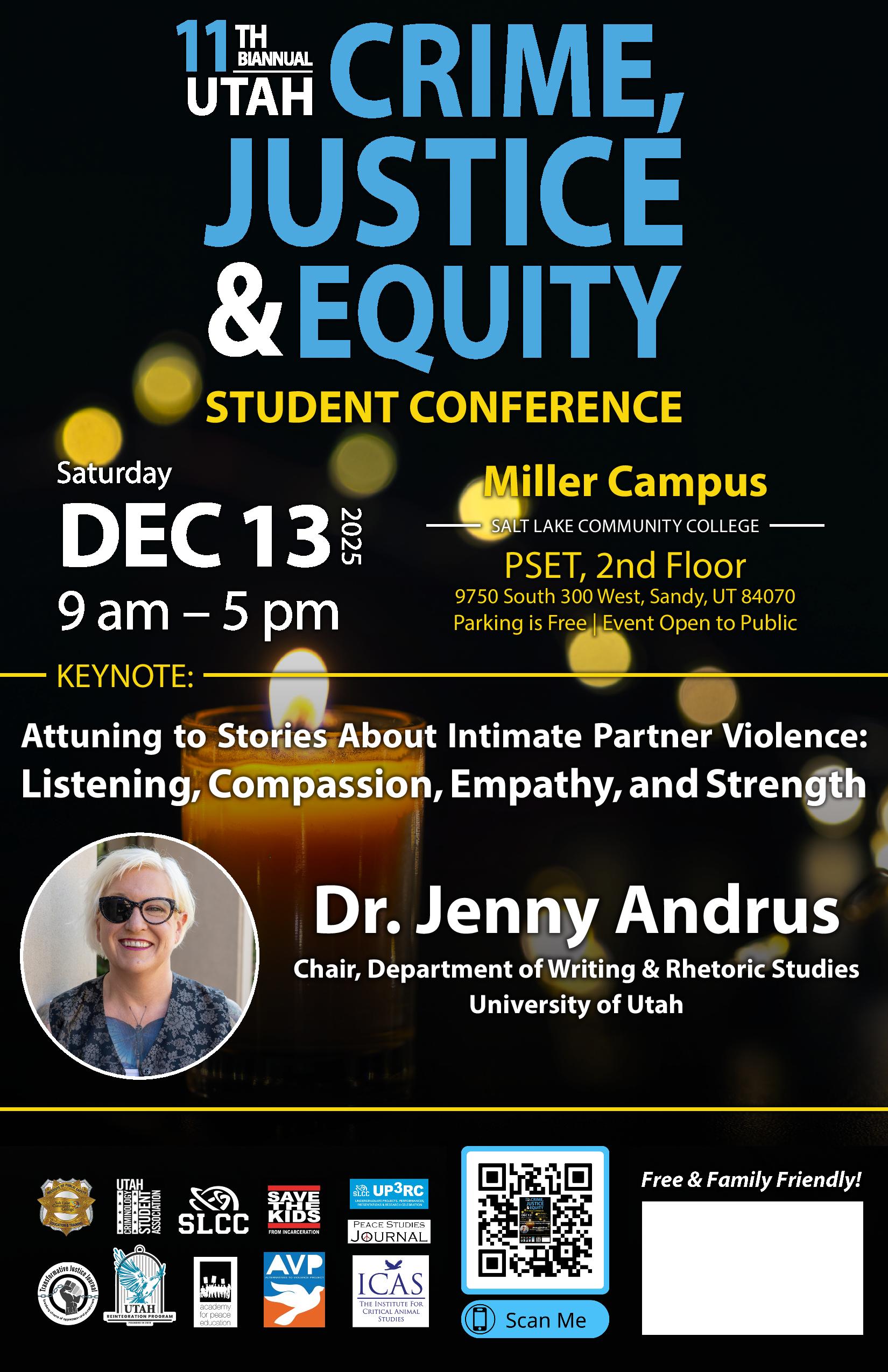
Free, Family Friendly, and Open to the Public.
Calling Utah undergraduate and graduate students
submit proposals to present or have posters here:
https://forms.office.com/r/bSFYptTx1r
Deadline for submissions is Friday, November 14, 2025
Conferences Chairs:
Professors Stephanie Hoffman, Anthony J. Nocella II, David Robles, and Antonette Gray
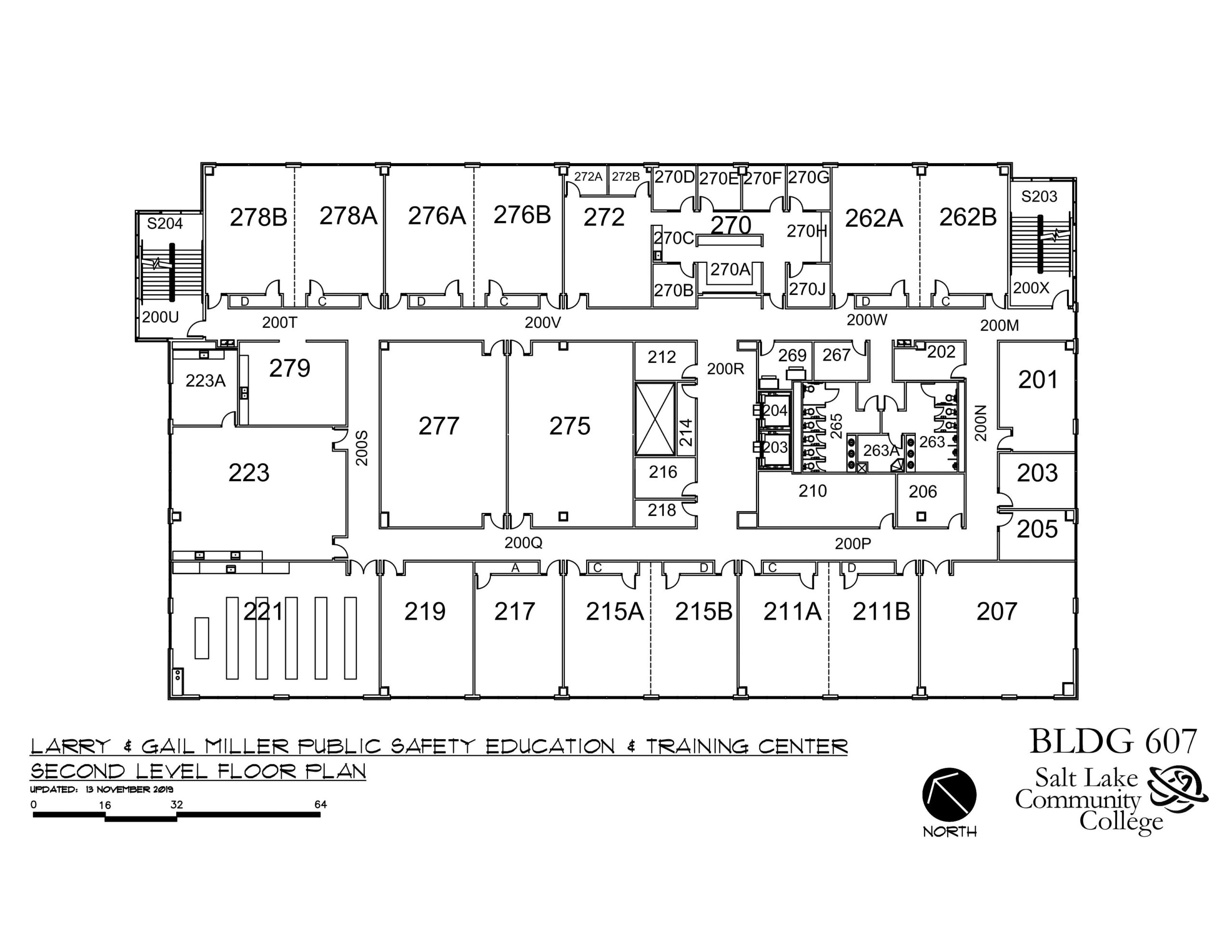
Rooms:
Room 1 (Zoom Streaming): PSET 215
https://slcc-edu.zoom.us/j/82284243633?pwd=CAx9ubNMdrolbK0YHO4C5ZbvSbFUkW.1
Meeting ID: 822 8424 3633
Passcode: 040401
Room 2: PSET 211
Room 3: PSET 215
Room 4: PSET 278
https://slcc-edu.zoom.us/j/88399802816?pwd=QoREtCu4kp1fMtQn2xRSVSoxmBt2af.1
Meeting ID: 883 9980 2816
Passcode: 325068
Forensic Science Lab Tour: PSET 221
Lunch and Awards Room: PSET 278
Agency and Organizations’ Booths Room: Hall Near Elevator
Posters: Hall
Conference Mission:
The Biannual Utah Crime, Justice, and Equity Conference, founded in 2019, hosted and sponsored by academic departments, colleges, universities, student clubs and nonprofits, is open to all undergraduate and graduate students in Utah to present within the field of justice studies, criminology, criminal justice, peace studies, and conflict studies. The purpose of this conference is to promote — scholarship, respect, community engagement, intellectual discovery, research, networking, collaboration, learning, innovation, inclusion, and a more educated democratic citizenship for a peaceful world.
SCHEDULE
(Based on USA Mountain Time)
8:40am– 5:00pm
Welcoming
8:40 – 9:00am
Session One
9:00am-10:00am
Room 1 (Zoom Streaming): PSET 215
Innocence Projects: The Devastating Implications of Wrongful Convictions
Chair: Antonette Gray, Associate Professor, Salt Lake Community College (SLCC)
Presenter One [9:00am-9:15am]
Title: Innocence Project Case: Alejandro Hernandez
Presenter: Karla Mayorga
Biography: Karla Mayorga is a Criminal Justice major in their sophomore year at Salt Lake Community College (SLCC). Karla aspires to become a Correctional Officer or Victim’s Advocate and intends to enroll in Salt Lake Community College’s (SLCC) Law Enforcement Academy (LEA) upon graduation.
Abstract: Alejandro Hernandez was wrongfully convicted of First-Degree Murder, Aggravated Kidnapping, and Aggravated Criminal Sexual Assault and was sentenced to death in 1985 in the state of Illinois. He served approximately 11 years in prison due to the following contributing causes: police and prosecutorial misconduct, use of false jailhouse informant testimony, coerced statements, suppression of exculpatory evidence, and confirmation bias during the investigation. Thankfully they were exonerated in 1995 after DNA testing conclusively proved his innocence and serial killer Brian Dugan confessed to the crime. The real perpetrator was thus identified and convicted. It is important to learn about this case because it highlights the devastating consequences of wrongful convictions and the urgent need for justice reforms, accountability in law enforcement, and the use of reliable forensic evidence to ensure that truth – not pressure to convict – guides every prosecution.
Presenter Two [9:20am-9:35am]
Title: Innocence Project Case: Charles Chatman
Presenter: Gabriel Smith
Biography: Gabriel Smith is a Criminal Justice major in their freshman year at Salt Lake Community College (SLCC). Gabriel aspires to become a Law Enforcement Officer and intends to transfer to Weber State University in Spring 2027 to complete their B.S. in Criminal Justice.
Abstract: Charles Allen Chatman was wrongfully convicted of Aggravated Rape and was sentenced to 99 years on 08/13/1981 in Dallas, Texas. They served 27 years due to the following contributing causes: eye-witness misidentification, and a lack of attorney preparation. Thankfully they were exonerated by Y-STR testing. The real perpetrator has yet to be identified. Learning about the Charles Allen Chatman case is important because it highlights the devastating impact that wrongful convictions can have on individuals, families, and society as a whole. Chatman lost 27 years of his life due to eyewitness misidentification and poor legal representation. Two of the most common causes of wrongful convictions in the United States. His case serves as a powerful reminder that the justice system is not infallible and must constantly be improved to protect the innocent.
Presenter Three [9:40am-9:55am]
Title: Innocence Project Case: Carlton Lewis
Presenter: Aileen Rojas Hernandez
Biography: Aileen Rojas Hernandez is a Criminal Justice major in their sophomore year at Salt Lake Community College (SLCC). Aileen aspires to become a Criminal Defense Attorney and intends to transfer to the University of Utah next year to complete their B.A. in Criminology.
Abstract: Carlton Lewis was wrongfully convicted of Second-Degree Murder and was sentenced to 20 years to life on 10/19/1992 in New York. They served 31 years due to the following contributing causes: false confessions or admissions and unvalidated or improper forensic science. Thankfully they were exonerated by DNA testing and the real perpetrators were identified as William McKee and Gregory Brown. The reason why it is so important to know about this case is just because someone claims there was an accomplice, does not necessarily mean it is true. This should be a great example to always go in depth and check a person’s credibility even if they say they saw someone commit a crime. It also reaffirms the need for DNA testing and to corroborate or disprove such statements.
*5 min. Q&A period after each 15 min. student presentation
Room 3: PSET 215
Chair: Anthony J. Nocella II, Associate Professor, Salt Lake Community College (SLCC)
Presenter One: Cambria Jones
Title: Becoming a Scholar Through Being a Guest Editor
Biography: Cambria Jones is a student at Salt Lake Community college majoring in sociology. She wants to graduate with a master’s degree in social work and work in reintegration programs for formally incarcerated individuals. Cambria grew up in Arizona till she was nine, then moved to Utah and has been there for a little over 10 years. Cambria is currently the president for the Utah Criminology Student Association at SLCC and likes to go on walks, see live music, and get coffee with friends in her free time.
Abstract: This presentation is focused on how to be a scholar as an undergraduate student through being a guest editor of the Peace Studies Journal.
Presenter Two: Cambria Jones
Title: Recidivism and Reintegration in the United States Criminal Justice System
Biography: Cambria Jones is a student at Salt Lake Community college majoring in sociology. She wants to graduate with a master’s degree in social work and work in reintegration programs for formally incarcerated individuals. Cambria grew up in Arizona till she was nine, then moved to Utah and has been there for a little over 10 years. Cambria is currently the president for the Utah Criminology Student Association at SLCC and likes to go on walks, see live music, and get coffee with friends in her free time.
Abstract: This essay explores recidivism as a major social issue connected to the punitive structure of the United States criminal justice system. The system has historically harmed marginalized communities and contributed to high rates of mass incarceration. Many formerly incarcerated individuals are released without the support they need to successfully return to society, which increases the risk of reoffending. Key factors that contribute to recidivism include limited access to employment, housing, education, health care, and the consistent violation of basic human rights during and after incarceration. The essay argues that focusing only on recidivism as a measure of success overlooks the larger goal of positive reintegration. Inadequate pre-release programs, often begin too late to make a meaningful impact, leaving individuals unprepared for
life after prison. After release, social stigma and the lack of follow up services create additional barriers to successful reentry. The effects of this cycle include prison overcrowding, exposure to negative influences, and long term emotional and social consequences. The essay also highlights how successful reintegration can reduce crime through family support, education, and employment opportunities. It concludes that prioritizing rehabilitation and basic human rights is essential for breaking the cycle of incarceration.
Presenter Three: Vinyl Farnsworth
Title: The Criminalization Of Transgender People In the United States
Biography: Vinyl Farnsworth is a student at the Salt Lake Community College majoring in music, with an emphasis on guitar. She hopes to become a professional session musician who specializes in guitar, although capable of playing consistently on six different instruments already. Farnsworth was born and raised in South Salt Lake City, with an older sister who shares an interest in music, but is more passionate about cinema. She spends most of her time studying music but also works on cars in her spare time, does community service work when able, and follows multiple different racing series.
Abstract: This report is about the inequitable treatment of transgender individuals within the United States, specifically in education, culture, healthcare, and government. This document is primarily focused on transgender adults however, that does not mean that transgender youth should be ignored or treated any differently. The information in this paper will highlight many of the ways that transgender people are discriminated against and treated differently in the United States. This paper supports the idea that transphobia is a major issue that not only hurts trans people but hurts humanity as a whole. Finally, this report concludes that anti transgender rhetoric is extremely damaging and must be assessed and handled in a way that is supported by unbiased scientific studies, and human rights organizations.
Presenter Four: Brogan Parker
Title: Why Right Wingers Shouldn’t Be Allowed To Own Guns
Biography: Brogan Parker is a student at Salt Lake Community College studying for an associate’s degree in political science. He was born in Las Vegas, Nevada shortly before moving to Salt Lake City, Utah. He wants to be a consultant for United States electoral candidates before running as a candidate himself. His hobbies are reading, volunteering, and Ceramics.
Abstract: Neoconservative individuals possess a higher risk of political violence factored by statistics and surveys of their moral circle. There is also soft precedent for partisan gun control in the United States, fostered by conservatives when towards political opposition, this paper argues that partisan gun control against neoconservative individuals is possible both with social precedent, and a proposed method of blacklisting neoconservative individuals and organizations from the purchase of firearms.
Presenter Five: Frida Cassanova
Title: Immigration in the U.S.
Biography: Frida Casanova is a current student at Salt Lake Community College majoring in Criminal Justice. She hopes to continue her schooling for her bachelors in forensics. Frida grew up in Mesa, Arizona and moved to Salt Lake, Utah when she was 8 years old with her family of four. First generation, Mexican American. Frida enjoys spending time with her friends and loved ones, going to new places and camping, kayaking and reading. Frida is passionate about making a difference in the justice system while working the Davis district jail.
Abstract: This paper is focused on the discrimination and prejudice within the U.S. criminal justice system related to illegal immigration. The Criminalization of immigration and it leading to mass incarceration of immigrants. The poor conditions in immigration detention centers and jail overuse and lack of due process. The Racial Profiling and Discriminatory Enforcement of immigrants are being disproportionately being targeted by law enforcement. The Misinformation about Immigrant crime, data and research shows that immigrants commit crimes at lower rates than a U.S. born citizen, by knowing this information there would be less public fear. Addressing these issues would require reforms that separate immigration enforcement from criminal law, ensuring due process is withheld and recognizing immigrants’ contributions to society.
Room 4: PSET 278
Innocence Projects: The Devastating Implications of Wrongful Convictions
Chair: Stephanie L. Hoffman, Associate Professor, Salt Lake Community College (SLCC)
Presenter One [9:00am-9:15am]
Title: Innocence Project Case:
Presenter:
Biography:
Abstract:
Presenter Two [9:20am-9:35am]
Title: Innocence Project Case: Keith Allen Harward
Presenter: Trinitee Ramirez
Biography: Trinitee Ramirez is a Criminal Justice major in their sophomore year at Salt Lake Community College (SLCC). Trinitee aspires to become a Forensic Scientist and intends to transfer to Utah Valley University (UVU) in Spring 2027 to complete their B.S. in Forensic Science.
Abstract: Keith Allen Harward was wrongfully convicted of Murder and Rape and was sentenced to life in prison on September 19th, 1982, in Virginia. They served thirty-three years due to the following contributing causes: eyewitness misidentification and unvalidated or improper forensic science. Thankfully they were exonerated by DNA testing and the real perpetrator was identified. It is important to understand and be able to identify the weaknesses in forensic science. We have to hold ourselves and the government responsible when things go wrong and correct the mistakes to prevent such miscarriages of justice.
Presenter Three [9:40am-9:55am]
Title: Innocence Project Case:
Presenter:
Biography:
Abstract:
*5 min. Q&A period after each 15 min. student presentation
Session Two
10:00am-11:00am
Room 1 (Zoom Streaming): PSET 215
Innocence Projects: The Devastating Implications of Wrongful Convictions
Chair: Antonette Gray, Associate Professor, Salt Lake Community College (SLCC)
Presenter One [10:00am-10:15am]
Title: Innocence Project Case: Roy Brown
Presenter: Darian Memmott
Biography: Darian Memmott is a Criminal Justice major in their sophomore year at Salt Lake Community College (SLCC). Darian aspires to become a Criminal Investigator and intends to transfer to the University of Utah next semester to complete their B.A. in Criminology.
Abstract: Roy Brown was wrongfully convicted of the 1991 murder of social worker Sabina Kulakowski in Cayuga County, New York. He was sentenced to 25 years to life in prison on January 23, 1992. Brown served 15 years due to contributing factors, including coerced testimony from a jailhouse informant and flawed forensic evidence, specifically bite mark analysis. He was exonerated on March 5, 2007, after DNA testing on saliva stains from the victim’s clothing excluded him and implicated another man, Barry Bench. The real perpetrator was identified, but as of the last reports, he had not been prosecuted. Studying this case is important because it underscores the critical need for accurate forensic methods and the dangers of relying on unreliable informant testimony. Learning from these mistakes and supporting reforms in forensic science and investigative procedures can help prevent similar miscarriages of justice in the future.
Presenter Two [10:20am-10:35am]
Title: Innocence Project Case: Marvin Grimm Jr.
Presenter: Sarah Kaderi
Biography: Sarah Kaderi is a Criminal Justice major in her sophomore year at Salt Lake Community College (SLCC). She plans to transfer to the University of Utah in Spring 2026 to complete her Bachelor of Science in Criminology. Sarah aspires to become a Criminal Defense Attorney, using her passion for forensic science and justice reform to advocate for the wrongfully accused. Her long term goal is to work toward preventing wrongful convictions through improved forensic accuracy, fair trials, and stronger accountability in the criminal justice system.
Abstract: Marvin Grimm Jr. was wrongfully convicted in 1976 of the rape and murder of 16-year-old Ursula Miliner in Virginia. He was sentenced to life in prison despite the lack of physical evidence directly linking him to the crime. Grimm served over 25 years before his exoneration in 2004. His wrongful conviction resulted from several contributing causes, including mistaken eyewitness identification, unreliable forensic analysis, and prosecutorial misconduct. Grimm was ultimately exonerated after advanced DNA testing, unavailable at the time of his trial, proved his innocence and excluded him as the source of biological evidence found at the scene. The real perpetrator was later identified through DNA comparison, confirming that the wrong man had spent decades imprisoned for a crime he did not commit. Studying Marvin Grimm Jr.’s case is essential for understanding how systemic errors and human bias can lead to devastating miscarriages of justice. It highlights the importance of modern forensic technology, ethical prosecution, and defense advocacy grounded in scientific integrity. Learning from cases like Grimm’s encourages future criminal justice professionals to uphold truth and accountability, ensuring that innocent individuals are protected and that no person is condemned without irrefutable evidence.
Presenter Three [10:40am-10:55am]
Title: Innocence Project Case:
Presenter:
Biography:
Abstract:
*5 min. Q&A period after each 15 min. student presentation
Room 2: PSET 211
Chair: David Robles, Assistant Professor, Salt Lake Community College (SLCC)
Presenter One: Ariana Ansari & Cristian Terrones Cardova
Biography: Ariana Ansari is a Health Science student at Salt Lake Community College with plans to transfer to Westminster University to complete her Bachelor’s in Nursing by 2027. Ariana is known for her diligence, compassion, and strong commitment to patient care. She is dedicated to building a career that makes a meaningful impact in healthcare. Christian Terrones is a Performing Arts student at Salt Lake Community College who is committed to community engagement, leadership, and social impact. Originally from Peru, he has lived independently in the United States for over three years while pursuing his academic and professional goals. As a peer leader in the Thayne Center, Christian is recognized for his dedication to supporting students, collaborating with campus partners, and actively participating in community service projects through the college. His work on campus reflects his passion for creating inclusive spaces and helping others feel connected and supported. Christian plans to continue growing as a leader, advocate, and storyteller, using his personal experiences and education to empower others and make a meaningful difference in his community.
Public Perception of Police and Identity in the United States: The research examines how Americans currently view the police and how these perceptions differ for Latino immigrants. The inquiry seeks to determine whether there is a nationwide “crisis of confidence” in law enforcement or whether distrust is concentrated within particular communities, shaped by race, immigration status, and lived experiences with police. National polling data indicate that the police remain among the more trusted public institutions in the United States, even as confidence in many other institutions has reached historic lows. In contrast, studies focusing on Black Americans, Latinos, and especially undocumented immigrants reveal profound mistrust and fear, with many individuals reluctant to contact the police, even during emergencies. To investigate this tension, the annotated bibliography is organized as follows: first, to review national public opinion; second, to examine racialized patterns of distrust; and finally, to analyze the specific experiences of Latino immigrant communities.
Presenter Two: Mabel Araus Munoz
Biography: Mabel Araus is a researcher and activist focusing on disability and social inclusion, with a particular interest in how disability intersects with American identity in the U.S. criminal justice system. Currently, she is developing a research project titled Disability and Inclusion in the U.S. Criminal Justice System: An International Comparison, examining the exclusion of people with disabilities in the U.S. and comparing it to more inclusive international models from Norway and New Zealand. In addition to her academic work, Mabel has extensive experience working with people with disabilities at social risk and those living in situations of homelessness in her home country. Through her work with local NGOs and community programs, she has developed a deep understanding of the challenges faced by marginalized populations, particularly those with disabilities. Graduating in business administration with a focus on social justice, Mabel’s academic work is deeply influenced by her personal experience as a person with a disability. Through her research, she aims to challenge punitive models of justice and advocate for a more inclusive, rehabilitation-focused criminal justice system.
Disability and Inclusion in the U.S. Criminal Justice System: An International Comparison (United States, Norway, and New Zealand): The exclusion of people with disabilities within the U.S. criminal justice system reveals how American identity has been shaped through punishment and marginalization. A comparative analysis with more inclusive models from Norway and New Zealand highlights the need to reimagine justice as rehabilitation and accessibility, focusing on disability inclusion. This research explores how disability intersects with American identity in the criminal justice system and examines what can be learned from international models that provide more inclusive accommodations for people with disabilities. The research methodology includes qualitative interviews with individuals with disabilities, academic literature on disability history and prison reform, and analysis of international policies such as New Zealand’s Disability Action Plan 2023-2027 and Norway’s rehabilitation model. A comparative study of incarceration practices and accessibility standards will be conducted to explore alternative models that prioritize rehabilitation and inclusion over punitive approaches. The expected outcomes of this project aim to highlight the importance of disability inclusion in the criminal justice system and propose ways the U.S. can adopt international best practices to improve accessibility, rehabilitation, and justice for individuals with disabilities.
Presenter Three: Thierno Badrou Bah
Biography: Thierno Bah is a student at Salt Lake Community College studying Computer Science. He is originally from Guinea and has lived in the United States since August 2021. Thierno is interested in understanding how identity, culture, and bias shape people’s everyday experiences, especially for immigrants and anyone seen as “different.” His own journey learning English, navigating new systems, and adjusting to American life informs his curiosity about how perception affects treatment. Thierno hopes to use his perspective and research to help others see how bias impacts real people and why awareness matters in conversations about justice and equity.
How the Concept of “Foreignness” Becomes “Suspicious” in the U.S. Criminal Legal System: This presentation explores how people in the United States often connect “foreignness” with suspicion, and how that connection shapes the way immigrants and those perceived as non-American are treated in the criminal legal system. Using research from academic studies, media analysis, and concepts from Biased, the project looks at how appearance, accent, stereotypes, and racialization influence who gets viewed as a threat. The presentation also examines how these perceptions affect policing, public trust, and everyday safety for immigrant communities. By bringing together research and personal perspective, this work highlights how bias especially unconscious bias can affect anyone who is seen as an outsider, regardless of their legal status or citizenship.
Presenter Four: Brianne Barros
Biography: Brianne Barros is a student at Salt Lake Community College, currently seeking a degree in Nursing. She is very passionate about taking care of others and takes pride in her ability to be empathetic towards others. Mental health awareness is especially important to her because she has lost several family members due to the severity of their conditions throughout her life. She hopes that shedding light on this topic will impact others in a positive way and guide those that are experiencing any mental health disparities.
Shedding Light on Mental Health Disparities: Mental health illnesses affect more than 1 in 5 adults and 1 in 7 youth in the United States each year. The numbers seem to be increasing as the years go by, especially for those that are criminalized or fatally shot when approached by law enforcement. The findings within the case studies that are being conducted each year reveal the truth behind the trainings provided to law enforcement officers or the lack thereof. Law enforcement officers are those who are first on the scene and should be equipped to handle any situation that comes their way. The objective of this research is to bring awareness to the mental health illnesses that one may be experiencing and the ways in which law enforcement interventions can be improved.
Presenter Five: Emilly Romero Hernandez
Biography: Emilly Romero is a business major in her sophomore year at Salt Lake Community. Although her major isn’t related to criminal justice, she is passionate about helping others in her community and likes to spread awareness on social injustices going on today.
Media Framing on Immigration: How the media frames immigration can shape public opinion and American identity. This influences which policies are made and supported. But is what the media says always true? This research presentation examines how the political climate affects the way media outlets present immigration, whether these sources are biased, the importance of media literacy, and how technologies such as artificial intelligence can spread even more misinformation. It also discusses the real impacts on immigrant communities, including discrimination, detention, and incarceration. The methodologies used are secondary research that includes data collection and analysis, and a comparative review of media sources. While this presentation focuses specifically on immigration, the findings highlight how essential media literacy is for understanding any topic.
Room 3: PSET 215
Chair: Anthony J. Nocella II, Associate Professor, Salt Lake Community College (SLCC)
Presenter One: Tyler Bremner
Title: The Rehabilitation Problem
Biography: Tyler Bremner is a twenty-one-year-old college student from Bountiful Utah. After graduating from Bountiful High School, he now studies international relations at Salt Lake Community College and plans to potentially transfer to the University of Utah to complete his degree and potentially work as a diplomat. In his free time enjoys playing volleyball, doing photography, hiking, building computers, and reading.
Abstract: The current punitive justice system works improperly if the goal is to rehabilitate and reintegrate individuals in prisons back into society without large levels of recidivism. Lack of research into new correctional systems, and lack of funding prevents improvement of the current system. Our justice system leads to significant mental health issues for prisoners. Returning citizens are not set up with the resources needed for success, and to prevent recidivism. If implementing technology, preventing overcrowding of prisons, implementing new courts focused on specific issues. And research was conducted and shared on a large-scale prisoners would already return on a better foot than before. Returning citizens when given resources to help their well-being such as employment opportunities and opportunities to expunge their records leads to a great reduction in recidivism as well. A change in focus from punishment to rehabilitation would lead to a greater more successful criminal justice system
Presenter Two: Charlotte McWhorter
Title: Heteronormative Bias in the U.S. Criminal Justice System
Biography: Charlotte McWhorter is a student at Salt Lake Community College, currently majoring in philosophy and religious studies. In the future, she plans to transfer to the University of Utah, where she will get her undergraduate degree in social work and begin exploring different opportunities in the mental health field. Charlotte grew up in Springdale, Arkansas, and is a part of the Utah Criminology Student Association. In her free time, she enjoys going on bike rides, trying out new cooking recipes, and spending time with friends and family.
Abstract: This paper is focused on the heteronormative bias within the U.S. criminal justice system and its effect on gender policing, exclusion in policies, and misplacement in the prison system. This paper argues that heteronormative structures throughout history have negatively impacted minority groups in the U.S., leading to unfair treatment and misrepresentation. Heteronormative representation glorifies heterosexual privilege and allows for the continuation of oppression against marginalized groups. This paper looks at the effects of heteronormativity on different areas of the criminal justice system and how it is constantly being reinforced throughout society.
Presenter Three: Illa Matthews
Title: Arrest Rate Discrimination in the U.S. Toward Immigrants
Biography: lla Matthews is a student at Salt Lake Community College, currently completing her general education courses while exploring her future career path. After finishing her general studies, she plans to transfer to the University of Utah to continue her studies. Illa grew up in Salt Lake City and values time with her family, striving to be supportive and caring. She volunteers at a local shelter, enjoys reading, gardening, hiking, and spending time with her friends. In her free time, she also loves to visit museums, attend art festivals, and go to concerts.
Abstract: This paper is focused on the discriminatory arrest rates targeting immigrants in the United States, despite evidence suggesting lower crime rates among immigrants compared to native- born citizens. This essay identifies key factors that contribute to these disparities, including racial profiling, the integration of criminal law, immigration enforcement, and biased policing practices. These factors lead to individual hardships such as deportation and family separation, as well as broader social impacts like the reinforcement of racial inequality and the community’s trust in law enforcement. Advocating for structural changes, including anti-profiling policies and community policing, alongside cultural shifts to combat harmful stereotypes and promote a more
equitable justice system. Addressing arrest-rate discrimination is crucial for upholding
constitutional ideals and fostering a more inclusive society.
Presenter Four: Anna Young
Title: Hiding Pride
Biography: Anna Young is a current full-time student at Salt Lake Community College majoring in criminal justice. Her goal is that in the future she will work in crime scene investigations in Oregon. Anna grew up in Utah all her life with her small family of three that shortly became just her overtime. Anna enjoys watching crime documentaries with her friends and loves to bake sweet goods and has six cats.
Abstract: This paper focuses on the ban of pride flags from being shown in and out of government properties in Utah. This paper argues that the state is trying to distinguish individuals from being themselves and openly showing homophobic tendencies towards it. In conclusion, the state of Utah is showing its hate towards many of its citizens by not allowing them to openly express themselves about their sexuality inside their community.
Presenter Five: Nex Hills
Title: Mass Incarceration of Youth and Youth Injustices
Biography: Nex Hills is a first year student at Salt Lake Community College and she is a psychology major who is taking a class in criminal justice. She hopes to transfer to the University of Utah. She has lived in Utah her whole life but has moved around throughout the state. In her free time she likes to be around people and participate in anything competitive.
Abstract: This essay goes into depth of the issues of mass incarceration within the juvenile justice system. It is an ongoing issue among the United States. There is an ongoing issue of mass incarceration especially of youth of color who are primarily targeted compared to white youth. This issue of mass incarceration especially among adolescents can be detrimental to those affected by it. Youth who are given life sentences at a young age is also an issue that fall into this category as it is, in some cases, unreasonable.
Presenter Six: Mckayla Elmer
Title: The Effects of Community-Based Policing on Crime Rates and Community Relations
Room 4: PSET 278
Innocence Projects: The Devastating Implications of Wrongful Convictions
Chair: Stephanie L. Hoffman, Associate Professor, Salt Lake Community College (SLCC)
Presenter One [10:00am-10:15am]
Title: Innocence Project Case: Gerard Richardson
Presenter: Olivia Sampson
Biography: Olivia Sampson is a Criminal Justice major in her freshman year at Salt Lake Community College (SLCC). Olivia aspires to become a Forensic Scientist (specializing in DNA or Bloodstain Pattern Analysis) and intends to transfer to the University of Missouri next spring to start the process of completing her B.S. in Forensic Science.
Abstract: Gerard Richardson was wrongfully convicted of murder and sentenced to 30 years without the possibility of parole on November 30, 1995, in New Jersey. He served nearly 19 years in prison due to the contributing causes of mistaken identification, flawed forensic evidence, and prosecutorial error. Thankfully, he was exonerated in 2013 through DNA testing conducted with the assistance of the Innocence Project, which proved that biological evidence from the crime scene did not match his DNA. The real perpetrator has yet to be identified. It is important to study this case to understand how critical accurate forensic testing and ethical investigative practices are in preventing wrongful convictions and ensuring justice for all.
Presenter Two [10:20am-10:35am]
Title: Innocence Project Case: Kenneth Adams
Presenter: L. N. Lam
Biography: L. N. Lam is a Criminal Justice major in their sophomore year at Salt Lake Community College (SLCC). L. aspires to become a Forensic Scientists and intends to transfer to Utah Valley University (UVU) in Fall 2026 to complete their B.S. in Forensic Science.
Abstract: Kenneth Adams was wrongfully convicted of murder, kidnapping, rape, and armed robbery and was sentenced to 75 years in March 1979 in Illinois. He served nearly 18 years due to the following contributing causes: coerced and false confessions, unreliable eyewitness testimony, jailhouse informant statements, and lack of physical or forensic evidence linking him to the crime. Thankfully, he was exonerated by DNA testing in 1996, which excluded him and the other members of the Ford Heights Four and identified the true perpetrators. The real perpetrators were subsequently identified, charged, and convicted. It is important to learn about this case to understand how flaws in investigations, reliance on unverified testimony, and inadequate forensic practices can lead to wrongful convictions. Studying this case emphasizes the need for reforms in interrogation methods, evidence handling, and the criminal justice system to prevent such miscarriages of justice in the future.
Presenter Three [10:40am-10:55am]
Title: Innocence Project Case: Calvin Washington
Presenter: Lauren Dirks
Biography: Lauren Dirks is a Criminal Justice major in their sophomore year at Salt Lake Community College (SLCC). Lauren aspires to become a Crime Scene Investigator (CSI) and intends to transfer to the University of Utah in Fall 2026 to complete their B.S. in Criminology.
Abstract: Calvin Washington was wrongfully convicted of aggravated sexual assault and capital murder and was sentenced to life in prison on December 11th 1987 in Texas. He served 14 years due to the following contributing causes: lack of evidence, unreliable witness testimony, racial bias, and police misconduct. Thankfully they were exonerated by advancements in DNA testing that proved his innocence. The real perpetrator was Benny Carroll. It is important to be educated on cases like Washington’s because it shows the importance of standards of practice in forensic investigations, as well as ensuring all suspects are given a fair and just trial.
*5 min. Q&A period after each 15 min. student presentation
Session Three
11:00am-12:00am
Room 1 (Zoom Streaming): PSET 215
Innocence Projects: The Devastating Implications of Wrongful Convictions
Chair: Antonette Gray, Associate Professor, Salt Lake Community College (SLCC)
Presenter One [11:00am-11:15am]
Title: Innocence Project Case: Alfred Swinton
Presenter: Matheus Ginatto
Biography: Matheus Ginatto is a Criminal Justice major in their sophomore year at Salt Lake Community College (SLCC). Matheus aspires to become a FBI Detective and intends to transfer to Utah Valley University (UVU) in Spring 2026 to complete their B.S in Criminal Justice.
Abstract: Alfred Swinton was wrongfully convicted of murder and was sentenced to 60 years on March 21, 2001 in Connecticut. He served 16 years due to the following contributing causes: unvalidated or improper forensic science (specifically, bite mark analysis) and eyewitness misidentification. Thankfully they were exonerated by DNA testing. The real perpetrator has yet to be identified. It is important to learn about this case because it serves as a critical and devastating example of how junk science, once accepted in a courtroom, can destroy a person’s life. This case highlights the urgent need to challenge and remove unvalidated forensic methods from the justice system to prevent such miscarriages of justice from happening again.
Presenter Two [11:20am-11:35am]
Title: Innocence Project Case: Angel Gonzalez
Presenter: Chris Cabrera
Biography: Chris Cabrera is a Criminal Justice major in their freshman year at Salt Lake Community College (SLCC). Chris aspires to become a Corrections Officer and intends to transfer to the University of Utah in Fall 2026 to complete their B.S. in Criminology.
Abstract: Angel Gonzalez was wrongfully convicted of Robbery and Assault and was sentenced to 12 years in 2015 in Utah. He served 6 years due to contributing causes such as mistaken eyewitness identification, mishandling of evidence, and lack of proper legal representation. Thankfully, he was exonerated after DNA evidence proved his innocence. The real perpetrator has yet to be identified. It is important to learn about this case to understand how mistakes in the justice system can destroy lives and to take action to prevent wrongful convictions in the future.
Presenter Three [11:40am-11:55am]
Title: Innocence Project Case: Franky Carrillo
Presenter: Alexander Garcia
Biography: Alex Garcia is a Criminal Justice major in their sophomore year at Salt Lake Community College (SLCC). Alex plans to pursue a career as a Criminal Investigator and transfer to the University of Utah in Fall 2026 to receive his B.S. in Criminology.
Abstract: Franky Carrillo was wrongfully convicted of Murderer (1 count) and Attempted Murder (6 counts) and sentenced to life in prison in 1992 in California. Due to eyewitness misidentification, police coercion, and unreliable witness testimony, Carrillo served 20 years before his exoneration in 2011 after witnesses recanted their statements and the Los Angeles County Superior court overturned his conviction. The real perpetrators were eventually revealed. This case should be studied because it highlights how procedural shortcomings from law enforcement agencies (i.e., suggestive line-ups) and reliance on eyewitness testimony can contribute to wrongful convictions. In addition, learning about such outcomes supports equity, transparency, and responsibility in the criminal justice system.
*5 min. Q&A period after each 15 min. student presentation
Room 2: PSET 211
Chair: David Robles, Assistant Professor, Salt Lake Community College (SLCC)
Presenter One: Ruston Davies
Biography: Ruston is a Physics and Math major at Salt Lake Community College, graduating with an Associates in Science in Spring 2026. After an 8 year hiatus from schooling and college, he returned with a renewed vigor and aspiration with the goal to graduate with a Master’s in Physics.
Career Prisoners: A look into Recidivism and Prisoner Treatment: This research explores the vicious cycle of reentry and recidivism of previously incarcerated individuals. It explores what might cause these individuals to recidivate, what is being done and what else might be done to reduce these rates. It explores how private prisons may promote recidivism due to certain practices that diminish the mental health of incarcerated individuals. It explores how the socioeconomic status and housing of these individuals post-release also promotes recidivism. Lastly, Ruston provides an argument for an expansion of the 13th amendment to remove slavery in its entirety providing rights to criminals.
Presenter Two: Mariah Espinal-Burns
Biography: Mariah Espinal-Burns is an Honors student who returned to SLCC after a 10-years, recommitting herself to higher education with renewed purpose and direction. With six years of experience in local government, she brings practical insight into how policy shapes communities. Her passion for public policy and advocacy is deeply rooted in personal and family experiences, which drive her commitment to advancing systems that are inclusive, comprehensive, and collaborative. Mariah’s work centers on strengthening civic engagement and elevating community voices, and she hopes to continue contributing to meaningful, people-focused change throughout her academic and professional journey.
Unalienable Worth: Dignity, Disability, and the American Contradiction: Unalienable Worth: Dignity, Disability, and the American Contradiction explores the tension between the nation’s founding promise of inherent human dignity and the realities faced by disabled people, the working class, and communities of color. These groups continue to navigate systems that undermine the ideals of equality and unalienable rights. Positioned as the antithesis of the “pull yourself up by your bootstraps” philosophy, this project also confronts the call to “Make America Entitled Again” by reframing entitlement as collective care and shared humanity—built on the unalienable rights and dignity of life, liberty, and the pursuit of happiness. Through historical analysis, policy research, and reflective inquiry, this project argues for systems that protect dignity, expand accessibility, and foster meaningful civic belonging for all.
Presenter Three: Ethan Mendenhall
Biography: Ethan is a second-year architecture student at Salt Lake Community College. He intends to transfer to the University of Utah to complete his Bachelor’s of Science in architecture and to eventually earn his license to practice. Ethan is a self-described polymath, aiming to transcend labels by means of them and is a lifelong student in science, art, and everything in between, including language and its power.
Language Is the Law: This research project explores the dynamics between language and legal outcomes in the United States. I explore two major kinds of dynamics; LEP individuals (limited English proficiency) in a courtroom setting, often with an interpreter present, and the dynamic of “legalese” speakers in interaction with either LEP individuals and/or native speakers of the courtroom’s language who are not educated in a legal field. We also look at some near-historical precedents in this field of research.
Presenter Four: Hailey Paiz
Biography: Hailey Paiz is a sophomore at Salt Lake Community College, majoring in Criminal Justice. She plans to transfer to the University of Utah in Fall 2026 to pursue a B.S. in Criminology. Passionate about making a positive impact, she empowers youth and children in her community by volunteering in local youth courts and community centers. She is committed to fostering fairness and supporting others, through her community involvement and her studies.
Sentenced by Perception: The Role of Identity in Legal Outcomes: This presentation explores how U.S. criminal sentencing affects Hispanic and Latino Americans and how their identity shapes the way they experience the legal system. It explores how being seen as Hispanic/Latino can contribute to sentencing disparities, creating differences in punishment and treatment. It will also examine how identity influences other experiences within the system, including victimization, access to services and recidivism rates. The goal is to bring awareness of how racial and ethnic biases appears throughout the U.S. legal system and how biases affect Hispanic/Latino individuals at different stages of the process.
Presenter Five: Gabriela Cordiglia
Biography: Gabriela Cordiglia is a first-year Kinesiology student at Salt Lake Community College who is passionate about human rights and criminal justice issues. She cares deeply about advocating for people who are vulnerable in the legal system, especially immigrants and asylum seekers. Through her research, Gabriela hopes to raise awareness about the psychological and social impact of detention and inspire change for a more humane system.
The Criminalization of Asylum Seekers: Psychological Trauma and Identity Harm in U.S. Immigration Detention: This presentation looks at how asylum seekers are treated in U.S. detention centers and how that treatment affects their mental health and sense of identity. Being held in jail-like facilities while seeking legal protection can cause serious psychological trauma, including anxiety, depression, and PTSD. I’ll be using three types of evidence: statistics on mental health outcomes, policy reviews showing how the asylum process has become punitive, and personal stories that show what detention feels like for real people. I want to focus on the human side of this issue and show why detaining asylum seekers is unnecessary and harmful, while also exploring possible ways to make the system more fair and compassionate.
Room 3: PSET 215
Chair: Anthony J. Nocella II, Associate Professor, Salt Lake Community College (SLCC)
Presenter One: Tyler Bremner
Title: Salt Lake Harvey Milk Murals
Biography: Tyler Bremner is a twenty-one-year-old college student from Bountiful Utah. After graduating from Bountiful High School, he now studies international relations at Salt Lake Community College and plans to potentially transfer to the University of Utah to complete his degree and potentially work as a diplomat. In his free time enjoys playing volleyball, doing photography, hiking, building computers, and reading.
Abstract: A discussion on the Salt Lake Murals and Harvey Milk
Presenter Two: Brogran
Title: Sharing Food With Unsheltered People in Salt Lake
Biography: Brogan Parker is a student at Salt Lake Community College studying for an associate’s degree in political science. He was born in Las Vegas, Nevada shortly before moving to Salt Lake City, Utah. He wants to be a consultant for United States electoral candidates before running as a candidate himself. His hobbies are reading, volunteering, and Ceramics.
Abstract: Discussion on economic justice and community building for those that are unsheltered nationally and in Salt Lake, Utah.
Presenter Three: Frida Casanova
Title: Harvey Milk and HB 261 in Utah
Biography: Frida Casanova is a current student at Salt Lake Community College majoring in Criminal Justice. She hopes to continue her schooling for her bachelors in forensics. Frida grew up in Mesa, Arizona and moved to Salt Lake, Utah when she was 8 years old with her family of four. First generation, Mexican American. Frida enjoys spending time with her friends and loved ones, going to new places and camping, kayaking and reading. Frida is passionate about making a difference in the justice system while working the Davis district jail.
Abstract: This presentation will be on why the Harvey Milk vigils in Salt Lake, Utah are important in the era of HB 261.
Presenter Four: Fabian Santiago Hernandez Torres
Title: Classism in the U.S. Bail System
Biography: I am a criminology student at Salt Lake Community College and I enjoy learning and growing within the field of social sciences. My academic and professional goals include working in community service and supporting communities facing challenges within the justice system. I grew up in an active family environment where I participated in various sports, such as soccer and other team activities. In my free time, I enjoy studying, learning new things, listening to music, socializing, spending time with friends and family, and playing video games.
Abstract: This system reinforces existing societal hierarchies, as defendants with greater
resources can easily pay bail, while those with fewer resources face difficulties because they lack the financial means to do so. If they cannot pay bail, these defendants must wait for their trial to see what the judge will decide. The examination indicates that preventive detentions have an impact on the defendants’ cases. In this essay, we can say that the current bail structure functions as a mechanism of oppression, perpetuating class inequality. We also suggest alternatives to provide opportunities for defendants, including support programs and programs that promote equity.
Presenter Five: Brianna Franco
Title: Harassment in Work Environment Towards Hispanics
Biography: Brianna Franco is a student at Salt Lake Community College who is currently taking a class in intro to criminal justice. She is graduating with a degree in fashion design hoping to have her own business, with a hope of going to Utah State University after SLCC.With the education she gains from this course she hopes to understand the system a little more and find ways to help the community. She likes to draw, hang out in parks and watch documentaries in her free time.
Abstract: This paper is focused on the racial discrimination and harassment towards hispanics in any work place. It emphazises the causes and consequences of workplace harassment Hispanic workers have experienced. Any type of discrimination can have an effect on a person’s performance, in the work place it causes a worker to be less productive as well as having a negative result towards the well-being of the worker. Discrimination comes in many different ways, sometimes even unintentional because it has become one of the issues where people do not realize it can have a long lasting effect. There are federal laws that create an equal work environment although it seems that it is still a recurring issue.
Presenter Six: Maria Gallardo
Title: The Influence that Child Trauma Can Have On Adult Criminal Behavior
Room 4: PSET 278
Innocence Projects: The Devastating Implications of Wrongful Convictions
Chair: Stephanie L. Hoffman, Associate Professor, Salt Lake Community College (SLCC)
Presenter One [11:00am-11:15am]
Title: Innocence Project Case: Arvin McGee
Presenter: Maddy Remley
Biography: Maddy Remley is a Criminal Justice major in their sophomore year at Salt Lake Community College (SLCC). Maddy aspires to become an FBI Agent and intends to transfer to the University of Utah in Spring 2026 to complete their B.S. in Criminology.
Abstract: Arvin McGee was wrongfully convicted of Rape, Kidnapping, Robbery, and Forcible Sodomy and was sentenced to 365 years in June of 1989 in Tulsa, Oklahoma. They served 12 years due to the following contributing causes: eyewitness misidentification and a lack of definitive physical evidence. Thankfully they were exonerated by DNA testing and the real perpetrator was identified (Edward Alberty). It is important to learn about this case because it explains what can happen when there is a lack of DNA testing and physical evidence. This case is a prominent example of the implications that can result when investigators do not do a thorough job. Arvin McGee lost 12 years of his life in prison for a crime he did not commit. DNA testing is what got him out of prison, and this case affirms the significance of post-conviction testing.
Presenter Two [11:20am-11:35am]
Title: Innocence Project Case: Curtis McCarty
Presenter: Whitney Romig
Biography: Whitney Romig is a Criminal Justice major in their sophomore year at Salt Lake Community College (SLCC). Whitney aspires to become a Crime Scene Investigator (CSI) and intends to transfer to Utah Valley University (UVU) in Spring 2026 to complete their B.S. in Forensic Science.
Abstract: Curtis McCarty was wrongfully convicted of First-Degree Murder and sentenced to death on May 24, 1986, in Oklahoma. He served 21 years due to the following contributing causes: forensic misconduct, false testimony, altered evidence, and improper crime lab procedures primarily tied to the misconduct of a forensic analyst (Joyce Gilchrist). Thankfully, he was exonerated by DNA testing that disproved the forensic claims used against him. The real perpetrator has yet to be identified. Learning about this case is essential because it highlights how flawed forensic practices and unethical conduct can destroy innocent lives, and it reinforces the need for strict oversight, proper evidence handling, and accountability in forensic science to prevent future miscarriages of justice.
Presenter Three [11:40am-11:55am]
Title: Innocence Project Case: Clemente Aguirre-Jarquin
Presenter: Gracelyn Rudy
Biography: Gracelyn Rudy is a Criminal Justice major in their sophomore year at Salt Lake Community College (SLCC). Gracelyn Rudy aspires to become a Criminal Psychologist and intends to transfer to the University of Utah in Spring 2026 to complete their B.S. in Criminology.
Abstract: Clemente Agurrie-Jarquin was wrongfully convicted of two counts of First-Degree Murder and Burglary with an Assault or Battery, and was sentenced to death on February 28, 2006, in Florida. They served 14 years due to the following contributing causes: improper forensic science, inadequate defense, and bias. Thankfully, they were exonerated after the prosecution dropped all charges during the retrial. The real perpetrator was identified as Samantha Williams. It is important to learn about cases like Clemente Agurrie-Jarquin because they highlight the failures of the criminal justice system. It also educates us on how to stop these miscarriages of justice in the future. By teaching those in positions of power about how critical ethics, truth, and proper procedure are, and having real consequences for those who would abuse their power, we can begin to fix what is broken in the system.
*5 min. Q&A period after each 15 min. student presentation
Lunch: 12:00pm to 12:30pm
Room: PSET 278
Facilitated by: Dr. Anthony Nocella II
Menu: Free Pizza and Juice (Vegan Options)
Moment of Silence for Lauren’s Promise: 12:30pm – 12:40pm
Room: PSET 278
Make Lauren’s Promise
Facilitated by: Interim Dean Cecile Delozier
Lauren’s Promise is a vow that anyone – faculty, staff, students, parents, and community members – can take to indicate to others that they represent a safe haven for sharing incidents of sexual assault, domestic violence, or stalking. Anyone who makes Lauren’s Promise will listen to and believe those individuals who are being threatened or experiencing sexual assault, dating violence or stalking and will help connect victims to support resources. By making Lauren’s Promise, individuals are helping to change campus cultures that respond poorly to dating violence and stalking throughout the nation.
I WILL LISTEN AND BELIEVE YOU IF SOMEONE IS THREATENING YOU.
Fill out the form below to make Lauren’s Promise and request more information about how you can improve safety on your campus.
12:40pm – 1:30pm – Keynote Speaker
Room: PSET 278
“Attuning to Stories About Intimate Partner Violence: Listening, Compassion, Empathy and Strength”
Dr. Jenny Andrus
Biography: Dr. Jennifer Andrus joined the University of Utah’s Writing Program in 2010, bringing with her a wealth of knowledge and expertise in Legal Rhetorics, Rhetorics of Domestic Violence, and Discourse Analysis. Over the past decade, she has made significant contributions to research and teaching, and proved to be an invaluable asset during the development of the Department of Writing & Rhetoric Studies. Professor Andrus is a prolific researcher and has published several articles, conference papers, and books. She comes highly decorated with multiple prestigious honors and awards, including the 2013 CCCC Technical and Scientific Award in the category of Best Original Collection of Essays. Dr. Andrus is also a passionate and inspiring educator who fosters academic excellence and intellectual curiosity in her students. Whether leading a class discussion or mentoring graduate students, Professor Andrus exercises her unwavering commitment and leads our young scholars to success.
Awards: 1:30pm-2:00pm
Room: PSET 278
Recognizing the Outstanding Criminal Justice Awards
Chairs: Professors Stephanie Hoffman and David Robles, Salt Lake Community College (SLCC)
Outstanding Academic Achievement:
This biannual award is for a graduating criminal justice student at Salt Lake Community College that has the highest GPA overall. This award is an objective award that does not have a nomination process and is determined by comparing all GPAs of criminal justice student majors that are graduating that academic semester.
Outstanding Inclusivity and Equity Achievement: Charlotte McWhorter
This biannual award is for a criminal justice student at Salt Lake Community College that has an active commitment and engagement in direct advocacy toward justice, equity, and inclusion of a marginalized segment of society such as, but not limited to, People of Color, immigrants, LGBTQ+, people with disabilities, those incarcerated, women, youth, survivors, unsheltered, economically disadvantaged people, nonhuman animals, and the environment. We recognize that oppression exists, and that action needs to be taken to address inequity and injustices in society.
Outstanding Service Achievement: Illa Matthews
This biannual award is for a criminal justice student at Salt Lake Community College that has an active commitment and engagement in serving voluntarily, and not as a paid job or internship, within the community at a government agency or social service nonprofit organization that is not religiously, or political party affiliated. Serving others and the community is a central part of justice and a healthy community.
Outstanding Health and Wellbeing Achievement: Alexa Lopez Enriquez
This biannual award is for a criminal justice student at Salt Lake Community College that has an active commitment and engagement in personal fitness, health, and mental wellbeing. We want to support students and not shame students for taking care of themselves over academics. As schools have led to a high rate of student anxiety, depression, unhealthy dietary and physical habits, and suicide. Further, the field of criminal justice has fostered similar habits too. This person must regularly demonstrate in their personal life selfcare, such as, but not limited, exercising, involvement in organized athletic competitions, eating healthy, and seeking out counseling and advising.
Outstanding Rise Up Achievement: Gina Rich, Nex Hills, Anna Young
This biannual award is for a criminal justice student at Salt Lake Community that has succeed against many personal social adversities, such as death in the family, unsheltered, drug use, incarceration, domestic violence, or theft.
Outstanding Scholarship Achievement Award: Haylie Ramirez, Kennedi Leon, Kylee Hermeling, Maria Padilla, and Cambria Jones
This biannual award is for a criminal justice student at Salt Lake Community that engages in research, scholarship, organizing academic publications and events, and participates in furthering their knowledge, education, and learning through reading, writing, attending forums, clubs, organization, and watching films.
Outstanding Faculty:
This annual award is dedicated to recognizing one adjunct or full-time faculty member in the Department of Criminal Justice at Salt Lake Community that demonstrates excellence in teaching, inclusion, equity of ideas and identity of individuals in our college community.
Session Four
2:00pm – 3:00pm
Room 1 (Zoom Streaming): PSET 215
Innocence Projects: The Devastating Implications of Wrongful Convictions
Chair: Antonette Gray, Associate Professor, Salt Lake Community College (SLCC)
Presenter One [2:00pm-2:15pm]
Title: Innocence Project Case: George Perrot
Presenter: Ethan Hardman
Biography: Ethan Hardman is a Criminal Justice major in their sophomore year at Salt Lake Community College (SLCC). Ethan aspires to become a Criminal Law Paralegal and intends to transfer to Brigham Young University (BYU) in Spring 2026 to complete their B.A. in Criminology & Law.
Abstract: George Perrot was wrongfully convicted of Aggravated Rape, Burglary, Assault in a Dwelling, Unarmed Robbery, Indecent Assault and Battery and was sentenced to life in prison on Dec. 14, 1987 in Massachusetts. They served 30 years due to the following contributing causes: faulty hair analysis, prosecutorial misconduct, and eyewitness misidentification. Thankfully they were exonerated by DNA testing proving the hair evidence used to convict him was not his, and the court ruled that the FBI’s microscopic hair comparison testimony was scientifically invalid and misleading. The real perpetrator has yet to be identified. This case highlights the dangers of faulty forensic evidence and prosecutorial misconduct. Learning from George Perrot’s wrongful conviction encourages stricter forensic standards, improved defense resources, and greater accountability to prevent future miscarriages of justice.
Presenter Two [2:20pm-2:35pm]
Title: Innocence Project Case: Timothy Brian Cole
Presenter: Wendi Trujano
Biography: Wendi is a Criminal Justice major in their sophomore year at Salt Lake Community College (SLCC). Wendi aspires to become a Juvenile Correctional Counselor and intends to transfer to Utah Valley University (UVU) in the future to complete their B.S. in Criminal Justice.
Abstract: Timothy Brian Cole was wrongfully convicted of Aggravated Sexual Assault and was sentenced to 25 years on September 17, 1986 in Lubbock County, Texas. They served 13 years due to the following contributing causes: eyewitness misidentification and unvalidated or improper forensic science. Thankfully they were exonerated by DNA testing that proved their innocence. The real perpetrator was identified. This case is important to learn about since it is a real life example on why we must fight for fair trials, accountability, and stronger safeguards against wrongful convictions.
Presenter Three [2:40pm-2:55pm]
Title: Innocence Project Case:
Presenter:
Biography:
Abstract:
*5 min. Q&A period after each 15 min. student presentation
Room 2: PSET 211
Chair: David Robles, Assistant Professor, Salt Lake Community College (SLCC)
Presenter One: Simon Lerma
Biography: Simon Lerma is a student at Salt Lake Community College. He moved to the State of Utah in the summer of 2019, and plans to graduate from community college in the Spring 2026. He plans to transfer to either Western Governors University or Weber State University in the Fall Semester of 2026, where he plans to pursue a Bachelor of Science degree and aspires to work in information technology and public relations. In addition to college, he enjoys writing, playing video games, and listening to music.
Native Hawaiian Identity and the Overrepresentation in the Carceral System: The identity of Native Hawaiians has been defined through a mixture of strong pre-colonial ties and contemporary cultural influences that have shaped what Hawaii is now, and these influences have also been shaped from adverse factors, which includes the justice system. Since the territorial period of Hawaii, the numbers of incarceration rates amongst Native Hawaiians have significantly increased, and it has been shown in various parts of modern Hawaiian society, primarily in carceral institutions, but also in historical and socioeconomic problems today.
Presenter Two: Vanessa Muntifering
Biography: Vanessa is an outgoing and social individual with a strong sense of justice and compassion for others. She is deeply passionate about advocating for victims, particularly youth, and strives to create meaningful change within the legal system. Vanessa plans to pursue a degree in law with the goal of becoming a lawyer dedicated to improving laws that protect and support young victims. Known for her determination, empathy, and strong communication skills, she approaches challenges with optimism and integrity. Vanessa’s drive to make a positive difference reflects her belief that justice should serve and uplift those most in need.
The Psychological Effects of Sexual Assault on Victims: This research explores the psychological effects of sexual assault on victims, emphasizing how trauma impacts long-term mental health and recovery. It examines conditions such as posttraumatic stress disorder (PTSD), depression, anxiety, and the complex emotional responses that follow victimization. The study also considers how external factors—such as social support, access to therapy, and institutional responses—shape the healing process. By analyzing both academic research and survivor perspectives, this project highlights the lasting consequences of sexual assault and the importance of understanding trauma from a compassionate, evidence-based standpoint. The goal is to raise awareness, reduce stigma, and encourage systems that better support survivors on their path to recovery.
Presenter Three: Nikolas Vidal
Biography: Nikolas Vidal is an Honors student majoring in Political Science, with a strong interest in global justice and social transformation. A product of living across cultures, he lends a particular insight into questions of identity, migration, and public policy. His academic work concerns the criminal legal system, human mobility, and holistic rehabilitation of society. Grounded in a commitment to equity and critical inquiry, Nikolas aims to challenge systems that divide communities and explore solutions that promote dignity, belonging, and collective well-being.
Borders, Identity, and Punishment: Rethinking Immigration Through an Open-Border Framework: This project proposes to explore how U.S. immigration enforcement impacts American identity and creates social problems among immigrants and minority communities. We aim to understand this relationship by using Juan Carlos Velasco’s philosophical framework of open borders as an analytic to deconstruct immigration enforcement mechanisms and laws. Our project will address the question “how does immigration enforcement impact national identity and social problems among immigrants and minority communities” by integrating findings on (1) legal analysis of the criminalization of undocumented immigrants as an immigration enforcement mechanism that impacts racial formation, (2) economic impact and data on how the militarization of immigration enforcement and discourse (production of public fear) fails to make us safer, and (3) how we may be able to support human mobility through deconstructing borders. From the analysis of these topics, we intend to draw the conclusion that “there are real alternatives to enforcement-centered approaches to immigration, and that shifting the conversation to a place where borders can be dismantled in the name of social and human dignity, and for the fundamental right to mobility, is a necessary step for establishing a more just sense of national identity.” This conclusion will be supported through key findings which may include, but are not limited to, the works of Eagly, who found that enforcement-based deterrence models are both ineffective and immoral; Golash-Boza, who found that this model is ineffective at achieving its stated aims; Kennan who provides real alternatives to current enforcement approaches to immigration; and Vezzoli who reveals the human and moral implications of our border system.
Presenter Four: Jay Tactay
Biography: Jay Tactay is the Youth Programs Director at the Utah Pride Center, where he leads community-driven initiatives for LGBTQ+ youth and builds inclusive events across Utah. With a background in advocacy, community organizing, and large-scale event planning, Jay focuses on empowering youth and expanding access to affirming resources. He is currently studying Criminal Justice at Salt Lake Community College, integrating his lived experience and community work into his academic path. Jay is committed to cultivating safer, more informed, and more equitable systems for marginalized youth.
The Criminalization of Queer and Trans Youth in America This presentation examines how queer and trans youth in the United States are often punished or criminalized because of their identities rather than their actions. Drawing on case studies, national reports, and peer-reviewed research, I look at how schools, shelters, policing, and the juvenile justice system treat LGBTQ+ youth differently from their cisgender and heterosexual peers. These patterns show up early through school discipline, shelter placements, and increased contact with law enforcement. As someone who experienced this growing up and now works with queer and trans youth, I want to highlight how these systems shape real outcomes and opportunities. This research aims to show why these injustices matter and what they reveal about identity, belonging, and fairness within the American criminal legal system.
Room 3: PSET 215
Chair: Anthony J. Nocella II, Associate Professor, Salt Lake Community College (SLCC)
Presenter One: Pierro Cotrina
Title: Immigration Enforcement & Criminalization in the United States of America
Biography: Piero Cotrina is a current student at Salt Lake Community College majoring in Business AS, He hopes to become an Administrator in Salt Lake City, Utah when He was 7 years, He always dreamed about been a leader and have his own company also He was a volunteer on Perú helping people in a small community in the North of Perú. He’s 24 years old.
Abstract: This paper explores the strong link between deportation practices and the criminalization of Latinos within the United States justice system. Although deportation is officially a civil process, it is increasingly used as a punitive measure that disproportionately targets Latino communities through programs like Secure Communities and 287(g), which allow local law enforcement to collaborate with federal immigration authorities. As a result, routine stops or minor infractions—such as traffic violations or lacking documentation—can lead to immigration detention and deportation. These practices are often driven by racial and ethnic bias rather than genuine threats to public safety, frequently affecting ordinary Latino workers, parents, and students. This leads to widespread family separation and fosters fear in entire communities, discouraging individuals from reporting crimes, seeking medical care, or utilizing public services. The cycle of fear weakens public trust and harms community well-being. The paper concludes by calling for comprehensive immigration reform that addresses racial profiling, separates civil immigration matters from criminal enforcement, and protects the human rights of Latino immigrants who are vital contributors to American society.
Presenter Two: Chyenne Johns
Title: Autism Awareness Towards Police
Biography: Chyenne Johns is a current student at Salt Lake Community College. She is studying Criminology she moved to Utah when she was about 5-years-old she was born in Pocatello, Idaho.
Abstract: This paper is focused on awareness towards 17-year-old Victor Perez who was shot and killed for having a meltdown. Victor Perez was born with nonverbal autism and many other development delays, when receiving the call to dispatchers the caller said “There’s a drunk man with a knife arguing with a Women” when police arrived to the scene they were telling Victor to drop the weapon Victor took one step and Pocatello Police shot Victor.
Presenter Three: Alexis Villegas Moreno
Title: Legalization of Drugs in the U.S.
Biography: My name is Alexis Villegas Moreno, and I am currently a student at SLCC and I’m taking thid class Introduction to Criminal Justice. I chose this class because I want to understand how the justice system works and how it impacts me and my community in different ways. I’ve had a little interest in how laws are created and how they can be changed to make society safer and fairer or how people find loopholes in the law and how the laws try to adapt to it. But outside of this or my school, I like to enjoy spending time with friends, playing soccer, and exploring new places really want to go hiking more. My goal is to work within the justice field to help make changes to help people or to change me in general by being more open to situations happening in real time. my focus right now is on this paper and how we should put people on rehabilitation and fairness rather than just punishment. Why I caught an interest in this because as a kid I use to
watch this youtuber my childhood youtuber called Popular MMOs later this person I watched fell into drug use and seemed like he kept getting arrested and nothing else until he was finally put on rehab. Makes me wonder what takes so long to help someone and why is it so quick to arrest someone and call it a solved problem.
Abstract: This paper focuses on the debate that is still occurring it is about the legalization of drugs. Within the United States criminal justice system, drug use and distribution are issues that have beenhandled wrong through punishment rather than prevention or education. The purpose of this paper is to discuss the legalization of drugs, while still giving strict rules. that could help reduce crime, improve safety, and change the focus from punishment to rehabilitation. Since drugs are already found everywhere you walk around or places you go to. both legally and illegally the current system of criminalizing users does more bad than good. Through legalization the government could better control substances and reduce imprisonment rates and change the direction of resources toward addiction treatment and education to help the people in need.
Presenter Four: Alexa Lopez
Title: Immigration and Customs Enforcement Immigration
Biography: Alexa Lopez is a current student at Salt Lake Community College majoring in forensic science. She hopes to become a criminal investigator in Orem, Utah. Alexa grew up in Salt Lake City, Utah and has Four siblings who enjoy shopping and watching movies. She plans to volunteer social services and enjoys taking part in homeless service, thrifting and spending time with family and taking pictures with camera. In addition to studying she works part-time and likes to collect albums. She also likes to spend time alone and go to concerts.
Abstract: This paper is focused on immigrants within the U.S criminal justice system related to discrimination and racism towards Latino people that are not U.S citizens that has always been a social issue. This paper argues that Immigration and Customs Enforcement immigration is a social issue within law enforcement in the U.S. There are results that show the rates of immigrants on economic, culture and social aspect. The outcome of this topic is we need to support our community and to express ourselves. There are thousands of immigrants being held in detention centers. Many immigrants are afraid of going out in public because they can be taken from Immigration and Customs Enforcement and not see their family personally. Social media plays a huge role in Immigration and Customs Enforcement immigration because they give you information on how they can track immigrants on their devices. Another social issue is
Immigration and Customs Enforcement is being too violent with immigrant people by using force there have been videos circulating around the internet of them breaking car windows, pinning them to the ground while pointing a gun, and pepper spraying them.
Presenter Five: Jordan White
Title: Classism and the Cycle of Incarceration in the U.S.
Biography: Jordan White is a current student at Salt Lake Community College majoring in psychology. They have been interested in psychology since taking advanced placement courses in high school, and they hope to become a neuropsychology technician. Jordan grew up in Salt Lake City with three older siblings. They have been drawing since they were ten years old and still find it to be their favorite hobby.
Abstract: This paper is focused on the discrimination and prejudice within the U.S. criminal justice system related to classism towards people living in poverty and the recidivism that often occurs for them. This paper argues that law enforcement criminalizes poverty and punishes people that struggle because of it. It also argues that the criminal justice system is deeply rooted in classism, and that it promotes socioeconomic discrimination. Instead of reasonable punishment for crimes,
the poor are often targeted because of their low-class status and community. Police encounters are not uncommon for people with low-income backgrounds, and incarceration frequently targets them, creating a cycle of recidivism and poverty.
Room 4: PSET 278
Innocence Projects: The Devastating Implications of Wrongful Convictions
Chair: Stephanie L. Hoffman, Associate Professor, Salt Lake Community College (SLCC)
Presenter One [2:00pm-2:15pm]
Title: Innocence Project Case: Steven Mark Chaney
Presenter: Madison Ruiz
Biography: Madison Ruiz is a Criminal Justice major in their sophomore year at Salt Lake Community College (SLCC). Madison aspires to become a Dental Hygienist and intends to pursue their RDH license and second associate’s degree in applied science through SLCC.
Abstract: Steven Mark Chaney was wrongfully convicted of the murder of John Sweek and received a life sentence on December 14th, 1987 in Texas. They served 28 years due to the following contributing causes: investigative tunnel vision, faulty and outdated forensic testing, bite mark analysis, lack of DNA testing, prosecutorial misconduct, and the withholding evidence. Thankfully they were exonerated by modern DNA testing completed by the Dallas County Conviction Integrity Unit and the Innocence Project. The real perpetrator has yet to be identified other than being determined to be an unknown male. This case shows us how forensic science and the criminal justice system can and will have misconduct and why we have strict regulations and rules that exist now due to cases like this, why it is important to always audit and evolve with scientific and technological advancements to ensure accurate methods to protect the innocent. Lack of oversight, ignored evidence and unreliable forensic science can destroy many lives and lose trust within the system. This is why it is important to take action and support projects like the Innocence Project and your local county conviction unit to prevent further miscarriages of justice.
Presenter Two [2:20pm-2:35pm]
Title: Innocence Project Case: Bennie Starks
Presenter: Bryce Beesley
Biography: Bryce Beesley is a Criminal Justice major in their sophomore year at Salt Lake Community College (SLCC). They aspire to become a Forensic Scientist and plan to transfer to Utah Valley University (UVU) next year to complete their B.S. in Forensic Science.
Abstract: Bennie Starks was wrongfully convicted of two counts of Aggravated Criminal Sexual Assault, one count of Attempted Aggravated Criminal Assault, one count of Aggravated Battery, and one count of Unlawful Restraint. He was sentenced to 100 years on September 25, 1986, in Illinois. He served 20 years due to the following contributing causes: flawed forensic science, eyewitness misidentification, and investigative failures. Thankfully, Starks was exonerated by advancements in DNA analysis. The real perpetrator was never further investigated or identified. Bennie Starks spent 20 years in prison and 7 additional years fighting for his full freedom. His case underscores the devastating impact that unreliable forensic practices and investigative errors can have on innocent lives. Forensic professionals must be committed to accuracy, objectivity, and ethical responsibility because when the pursuit of conviction replaces the pursuit of truth, the justice system fails.
Presenter Three [2:40pm-2:55pm]
Title: Innocence Project Case:
Presenter:
Biography:
Abstract:
*5 min. Q&A period after each 15 min. student presentation
Session Five
3:00pm – 4:00pm
Room 1 (Zoom Streaming): PSET 215
Innocence Projects: The Devastating Implications of Wrongful Convictions
Chair: Antonette Gray, Associate Professor, Salt Lake Community College (SLCC)
Presenter One [3:00pm-3:15pm]
Title: Innocence Project Case: Leonard Mack
Presenter: Mikayla Baer
Biography: Mikayla Baer is a Criminal Justice Major in her sophomore year at Salt Lake Community College (SLCC). Mikayla aspires to become a Detective and intends to transfer to Peace Officer Standards and Training (POST) academy next year to complete her certification.
Abstract: Leonard Mack was wrongfully convicted of First-Degree Rape and two counts of Criminal Possession of a Weapon and was sentenced to 7.5–15 years on March 29th, 1976 in New York. He served 7.5 years in prison, 2.5 on parole, and 37 years as a sex offender, due to the following contributing causes: improper forensic analysis and conclusion, and suggestive witness identification and testimony. Thankfully he was exonerated by DNA testing and the real perpetrator was identified. It is important to learn about this case and take action to prevent such miscarriages of justice going forward because this is a prime example of how racial bias and incorrect procedures can have lasting implications on an innocent person’s life even after prison.
Presenter Two [3:20pm-3:35pm]
Title: Innocence Project Case:
Presenter:
Biography:
Abstract:
Presenter Three [3:40pm-3:55pm]
Title: Innocence Project Case:
Presenter:
Biography:
Abstract:
*5 min. Q&A period after each 15 min. student presentation
Room 215:
Chair: Anthony J. Nocella II
Presenter One: Rebecca Inman
Title: Mass Incarceration
Presenter Two:
Presenter Three:
Presenter Four:
Presenter Five:
Room 4: PSET 278
Innocence Projects: The Devastating Implications of Wrongful Convictions
Chair: Stephanie L. Hoffman, Associate Professor, Salt Lake Community College (SLCC)
Presenter One [3:00pm-3:15pm]
Title: Innocence Project Case: Herman Atkins
Presenter: Steve Navarro
Biography: Steve is a Criminal Justice major in their sophomore year at Salt Lake Community College (SLCC). Steve aspires to become a Medical Examiner Investigator (MDI) and intends to transfer to Utah Valley University (UVU) in Fall 2026 to complete their B.S in Criminal Justice.
Abstract: Herman Atkins was wrongfully convicted of 2 counts of Forcible Rape, 2 counts of Forcible Oral Cop., and Robbery and was sentenced to 45 years on September 8th, 1988, in California. They served 12 years due to the following contributing causes: eyewitness misidentification and unvalidated or improper forensic science. Thankfully they were exonerated by DNA testing, but the real perpetrator has yet to be identified. The case of Herman Atkins is crucial reminder that justice is only as strong as the evidence that supports it. His wrongful conviction, built on mistaken identification, flawed forensic science, and systemic bias all shows how easily truth can be overshadowed by assumption. Studying this case can encourage us to confront weaknesses within our legal system, advocate for stronger scientific standards, and support reforms that protect both victims and the innocent.
Presenter Two [3:20pm-3:35pm]
Title: Innocence Project Case: Ron Williamson
Presenter: Sean Nydegger
Biography: Sean Nydegger is a Criminal Justice major in their sophomore year at Salt Lake Community College (SLCC). Sean aspires to become a Police Officer and intends to transfer to the University of Utah next year to complete their B.S. in Criminology.
Abstract: Ron Williamson was wrongfully convicted of Murder and was sentenced to death on 04/28/1988 in Oklahoma. They served 11 years due to the following contributing causes: false confessions or admissions, government misconduct, inadequate defense, informants, and unvalidated or improper forensic science. Thankfully they were exonerated by DNA testing and the real perpetrator was identified. Learning about this case can educate people on government misconduct, false testimony, flawed forensics, and wrongful convictions.
Presenter Three [3:40pm-3:55pm]
Title: Innocence Project Case: Alan Crotzer
Presenter: Samuel Scott
Biography: Samuel Scott is a Criminal Justice major in their freshman year at Salt Lake Community College (SLCC). Samuel aspires to become a Law Enforcement Officer and intends to transfer to Utah State next fall with the hopes of graduating in 2028 with a B.S. in Criminal Justice.
Abstract: Alan Jerome Crotzer was wrongfully convicted of Sexual battery, Kidnapping, Robbery, Burglary, Aggravated Assault and False Imprisonment and was sentenced to 130 years on April 22, 1982, in Florida. He served 25 years of his sentence due to the following contributing causes: lack of physical evidence, eyewitness misidentification, improper forensic science, and his association with the codefendant. Thankfully he was exonerated by DNA analysis, lawyer advocacy, and post-conviction testing. The real perpetrator has yet to be identified. This case is crucial to learn about because it shows what happens when there is only limited circumstantial evidence and investigators, attorneys, and scientists fail to address its shortcomings and make efforts to corroborate it with more definitive evidence.
*5 min. Q&A period after each 15 min. student presentation
Session Six
4:00pm – 5:00pm
Room 1 (Zoom Streaming): PSET 215
Innocence Projects: The Devastating Implications of Wrongful Convictions
Chair: Antonette Gray, Associate Professor, Salt Lake Community College (SLCC)
Presenter One [4:00pm-4:15pm]
Title: Innocence Project Case: Ralph Armstrong
Presenter: Annalisa Esquibel
Biography: Annalisa Esquibel is a Criminal Justice major in their sophomore year at Salt Lake Community College (SLCC). Annalisa aspires to become a Parole Officer and intends to transfer to the University of Utah in Spring 2026 to complete their B.S. in Criminology.
Abstract: Ralph Armstrong was wrongfully convicted of First-Degree Murder, and First-Degree Sexual Assault and was sentenced to life, plus 16 years in prison on March 24, 1981, in Wisconsin. They served 28 years due to the following contributing causes: eyewitness misidentification, government misconduct, and unvalidated or improper forensic science. Thankfully, they were later exonerated after the suppression of exculpatory evidence and prosecutorial misconduct was identified. The real perpetrator was identified as his brother. It is important to learn about the Ralph Armstrong case to understand wrongful convictions, the importance of DNA evidence, the possible flaws in forensic science/testimony, and how important it is to have organizations committed to legal reform. Preventing miscarriages of justice is important to ensure true justice, prevent innocent people from being convicted, and maintain the public’s trust.
Presenter Two [4:20pm-4:35pm]
Title: Innocence Project Case: Archie Williams
Presenter: Carlos Tafoya
Biography: Carlos A. Tafoya is a Criminal Justice major in their sophomore year at Salt Lake Community College (SLCC). Carlos aspires to become a Homicide Investigator and intends to transfer to Weber State University in Fall 2026 to complete their B.S. in Psychology.
Abstract: Archie Williams was wrongfully convicted of Attempted Murder, Aggravated Rape, and Aggravated Burglary and was sentenced to life on April 21st, 1983 in Louisiana. They served 35 years due to the following contributing causes: faulty eyewitness identification and a lack of definitive evidence. Thankfully they were exonerated by post-conviction DNA analysis that identified the real perpetrator, Stephen Forbes. Archie Williams’s horrific ordeal and conviction reveals how unreliable eyewitness accounts can be and that a lack of DNA testing can tragically condemn an innocent person to rot in prison for a crime they did not commit, whilst the real perpetrator runs free. By implementing reforms in identification procedures and ensuring comprehensive post‐conviction DNA review, we can help prevent such miscarriages of justice in the future.
Presenter Three [4:40pm-4:55pm]
Title: Innocence Project Case: Eddie Lee Howard
Presenter: Adar Mowlid
Biography: Adar Mowlid is a Criminal Justice major in her sophomore year at Salt Lake Community College (SLCC). Adar aspires to become a Criminal Lawyer and intends to transfer to the University of Utah in Fall 2026, to complete her B.S. in Criminology or Political Science.
Abstract: In 2000, Eddie Lee Howard was wrongfully convicted of the capital murder of 84-year-old Georgia Kemp in Columbus, Mississippi. He spent 26 years on death row due to the following contributing causes: faulty bite-marks analysis, prosecutorial misconduct, and poor legal counsel. He was exonerated in 2021, thanks to DNA testing that established his innocence and discredited the forensic bitemark analysis against him. The actual offender has yet to be identified. This case highlights the dire necessity for greater forensic science rigor and regulation of expert testimony. Knowledge of cases such as his are crucial to avoid future miscarriages of justice. Science and law must work in tandem with ethics and precision in matters that are aimed at the truth.
*5 min. Q&A period after each 15 min. student presentation
Room 4: PSET 278
Innocence Projects: The Devastating Implications of Wrongful Convictions
Chair: Stephanie L. Hoffman, Associate Professor, Salt Lake Community College (SLCC)
Presenter One [4:00pm-4:15pm]
Title: Innocence Project Case: Robert DuBoise
Presenter: Brynli MacLeod
Biography: Brynli MacLeod is a Criminal Justice major in their sophomore year at Salt Lake Community College (SLCC). Brynli aspires to become a Forensic Scientist and intends to transfer to Utah Valley University (UVU) next Fall to complete their B.S. in Forensic Science.
Abstract: Robert DuBoise was wrongfully convicted of 1st Degree Murder and Rape and was sentenced to life on March 7, 1985 in Tampa, FL. They served 37 years due to the following contributing causes: false eyewitness testimony and a bite mark. Thankfully, they were exonerated by DNA testing and the real perpetrators (Amos Robinson and Abron Scott) were identified. It is important to learn about these types of cases to ensure wrongful convictions do not continue to occur and that the actual perpetrators are brought to justice.
Presenter Two [4:20pm-4:35pm]
Title: Innocence Project Case: Michelle Murphy
Presenter: Brooke Hanna
Biography: Brooke Hanna is a Criminal Justice major in their sophomore year at Salt Lake Community College (SLCC). Brooke aspires to become a Lawyer and intends to transfer to Weber State next in Summer 2026 to complete their B.S. in Criminal Justice.
Abstract: Michelle Murphy was wrongfully convicted of First Degree Murder and was sentenced to life without parole in November of 1995 in Oklahoma. They served 20 years due to the following contributing causes: a confession, an eye witness, misleading courtroom testimony from the prosecutor concerning the blood analysis, and prosecutorial and investigative bias. Thankfully they were exonerated by DNA evidence where the blood at the crime scene excluded her. The real perpetrator was never identified. Examining the circumstances surrounding Michelle Murphy’s arrest, the evidence, trial, and exoneration, show the immense human toll wrongful convictions can have and emphasizes the importance of forensic and legal advocacy in securing justice.
Presenter Three [4:40pm-4:55pm]
Title: Innocence Project Case: Earl Washington
Presenter: Kaden Olson
Biography: Kaden Olson is a Criminal Justice major in their sophomore year at Salt Lake Community College (SLCC). Kaden aspires to become an Intelligence Analyst and intends to transfer to Utah Valley University (UVU) in Fall 2026 to complete their B.S. in Criminal Justice.
Abstract: Earl Washington was wrongfully convicted of Murder and Rape and was sentenced to life on January 20th, 1984 in the state of Virginia. They served 16 years due to the following contributing causes: false confessions or admissions and unvalidated or improper forensic science. Thankfully they were exonerated by advancements in DNA testing and the real perpetrator Kenneth Tinsley was identified. It is important to learn about this case because learning about the mistakes made by others that led to the wrongful conviction can help protect the innocent in the future.
*5 min. Q&A period after each 15 min. student presentation
5:00pm – End of Conference
![Official Statement – Save the Kids Official Statement on the organization – Save The Children [Fund]](https://savethekidsgroup.org/wp-content/uploads/2019/11/Save-the-Kids-Official-Statement-header.jpg)